Short Answer
To focus better in doubles pickleball, stop trying to think about everything at once. From the Fluid Motion Factor perspective, better doubles focus comes from simplifying your job: soften your eyes, receive the ball, stay aware of your partner, move with the court, and use short communication. The goal is not to concentrate harder. The goal is to give your body a cleaner assignment.
Doubles Gives the Mind Too Many Jobs
Doubles pickleball is a little like trying to have a quiet thought in a room where four people are waving paddles, the ball is changing speeds, your partner is making small noises, and one opponent is standing at the kitchen line looking as if he has just discovered a loophole in the laws of physics.
No wonder people lose focus.
In singles, the problem is usually simple enough to understand. You are responsible for everything, which is exhausting, but at least the story has only one main character.
In doubles, the mind has more places to wander.
Your shot.
Your partner’s shot.
Their shot.
Who has the middle.
Whether you should poach.
Whether you should have poached.
Whether your partner thinks you should have poached.
Whether your partner’s partner in life, watching from a folding chair, also thinks you should have poached.
That is a lot of committee work for one little brain.
From the Fluid Motion Factor point of view, better focus in doubles does not come from trying harder to concentrate. In fact, trying harder is often the problem. The more the thinking brain attempts to manage every possibility, the more the body loses the natural timing, feel, and responsiveness that good pickleball depends on.
The goal is not to think more.
The goal is to give the body a cleaner job.
Doubles Focus Begins With Shared Simplicity
Most doubles confusion comes from too many mental assignments.
One player is thinking, “I need to keep it deep, protect the middle, watch the lob, cover my line, help my partner, attack anything high, avoid popping it up, and please, for the love of all kitchen-line civilization, do not miss another return.”
That may be a reasonable list in a coaching manual.
It is not a useful thought while a ball is flying at you.
The Fluid Motion Factor approach begins by simplifying the focus. In doubles, that often means choosing one small organizing cue for the rally:
- See the ball early.
- Soften the eyes.
- Feel the paddle.
- Move with your partner.
- Receive before you decide.
Those are not technical instructions in the usual sense. They are invitations. They bring the body back into the point without forcing the thinking brain to become the general manager of every muscle fiber.
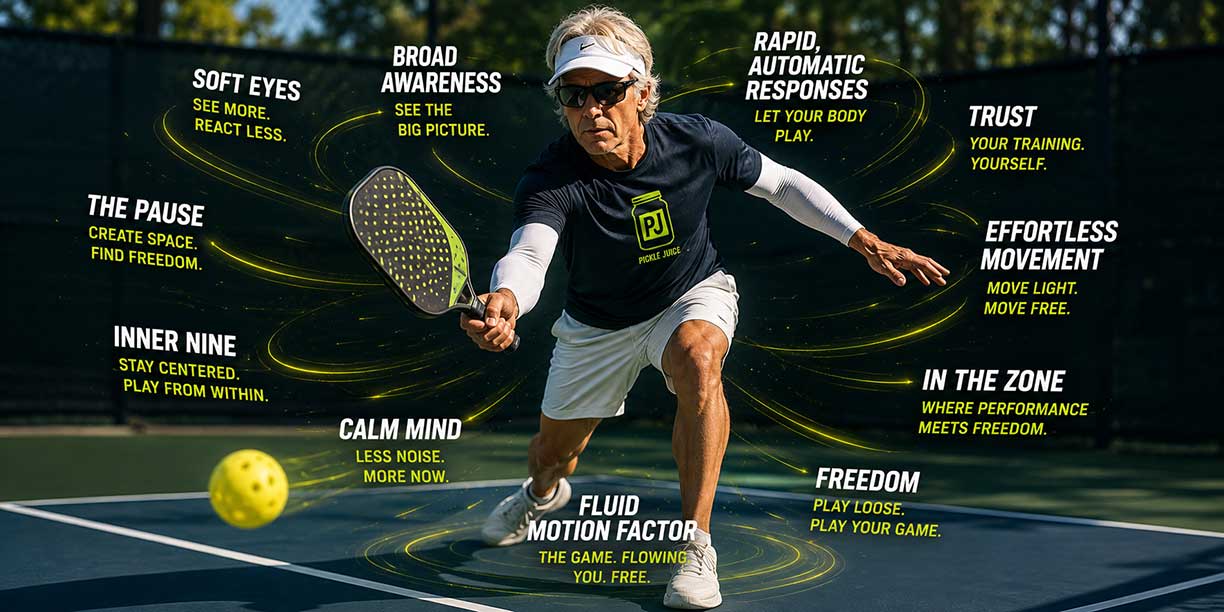
Soft Eyes Help You See the Whole Court
A common mistake in doubles is hard visual focus. Players stare at the ball as if intensity itself will improve contact. But hard focus can narrow awareness. The ball becomes everything, and the court disappears.
That is a problem because doubles is not just about the ball.
It is also about spacing. Opponent movement. Partner movement. Paddle positions. Openings. Pressure. The shape of the rally.
Soft eyes do not mean vague eyes. They mean receptive eyes.
You still see the ball, but you also allow the court to remain present around it. You are not staring a hole through the ball. You are letting the whole scene come to you.
This is especially useful at the kitchen line, where the game becomes fast, subtle, and occasionally rude. A hard-eyed player may react late because everything feels sudden. A soft-eyed player often seems to have more time, not because the ball is slower, but because the body is not waiting for a verbal report from headquarters.
It sees.
It senses.
It responds.
Stop Auditing Your Partner
One of the quickest ways to lose focus in doubles is to start evaluating your partner during the point.
Why did he hit that?
Why didn’t she come in?
Why are we still back?
Why is he standing there?
Why did she leave me that ball?
Why has civilization failed?
The moment you begin auditing your partner, your own movement usually gets worse. You are no longer in the point. You are in a small mental balcony, reviewing the performance.
This does not mean partners should never communicate. They should. Good doubles requires clear calls, shared patterns, and a basic agreement about who takes the middle.
But during the rally, judgment is expensive.
It costs timing, touch, and trust.
The better FMF cue is:
Play with what is happening.
Not what should have happened. Not what your partner might have done. Not what you plan to explain later using hand gestures and a tone of saintly restraint.
What is happening now.
If your partner hits a weak shot, your job is not to be disappointed. Your job is to respond. If your partner pulls you out of position, your job is not to compose an internal legal brief. Your job is to recover the shape of the point.
Doubles focus improves when both players stop trying to be historians.
Move as a Pair, Not as Two Separate Appliances
Good doubles teams often look calm because they move together. Not perfectly. Not robotically. But with a shared sense of spacing.
When one player is pulled wide, the other shades toward the middle. When one moves forward, the other usually moves forward. When one is pushed back, the other understands the court has changed.
This kind of movement is hard to create if each player is trapped inside a private instruction manual.
The FMF approach is to feel the relationship:
Where is my partner?
Where is the pressure?
Where is the open space?
Where is the next likely ball?
Again, this is not meant to become a checklist. It is more like peripheral awareness. You feel the court as a living arrangement rather than a diagram.
In that sense, doubles is not just shot-making.
It is choreography with consequences.
Use Simple Communication, Then Let It Go
Some focus problems in doubles come from silence. Other focus problems come from too much talking.
Good communication is short, timely, and useful:
- Mine.
- Yours.
- Switch.
- Stay.
- Watch middle.
- Let it go.
Long explanations generally belong between games, not between balls. The nervous system does not need a podcast while preparing to return serve.
Even between points, keep communication clean. A partner who receives a lecture after every rally begins playing with two opponents and one supervisor.
That is not a recipe for flow.
A useful doubles phrase is:
Information, not emotion.
Instead of “You keep leaving the middle open,” try “Let’s shade middle on their forehand.”
Instead of “Why did you hit that?” try “Let’s make them dink one more.”
Instead of “Don’t pop it up,” try “Soft hands here.”
The words should reduce noise, not add weather.
Focus on the Ball You Can Actually Play
Doubles tempts players to think about balls that are not theirs.
You may start leaning toward your partner’s shot. You may prepare for a poach that does not exist. You may watch the opponent across from your partner and forget the opponent in front of you. You may get so interested in strategy that the next ball arrives like an unpaid bill.
A simple FMF doubles cue is:
Receive your ball.
That does not mean being passive. It means letting the ball arrive into your awareness before you impose a decision on it.
Many mistakes happen because players decide too early. They have already chosen attack, speed-up, dink, lob, or Erne-shaped glory before the ball has fully declared itself.
Receiving the ball gives the body a fraction more time to organize. The shot becomes less forced. The paddle face gets quieter. The movement becomes more connected.
In doubles, this matters because one forced shot can turn into four people scrambling around like a committee trying to catch a squirrel.
Reset Together After Mistakes
Every doubles team needs a reset.
Not a dramatic one. Not a group therapy session at the baseline. Just a reliable way to return to the next point.
A simple doubles reset might be:
- Paddle tap.
- Breath.
- Soft eyes.
- One shared cue.
That cue might be:
- Middle.
- Deep return.
- Make them play.
- Easy hands.
- Next ball.
The important thing is that both players feel the point is over. The miss does not become a fog that rolls into the next rally.
From the Fluid Motion Factor perspective, this is crucial because emotional residue creates physical residue.
Irritation tightens the grip.
Embarrassment rushes the feet.
Anxiety narrows the eyes.
Over-eagerness turns touch into shove.
The reset clears the system.
Not perfectly. We are still human beings, unfortunately.
But enough.
Better Focus Feels Like Connection, Not Concentration
Most players think focus means bearing down. They furrow the brow, grip the paddle, and try to become mentally tougher.
Sometimes this works for about two shots. Then the body starts to feel like it is playing in a rented tuxedo.
FMF points in a different direction.
Better focus in doubles is not grim concentration.
It is connection.
Connection to the ball.
Connection to your partner.
Connection to the court.
Connection to timing.
Connection to the feel of the paddle in your hand.
When those connections are present, the thinking mind does not have to disappear, but it does have to stop driving from the back seat with a flashlight and a clipboard.
A Simple Doubles Focus System
Here is a practical version you can use immediately:
Before the serve or return: soften the eyes and feel your feet.
As the ball comes: receive it before deciding.
During the rally: stay aware of partner spacing and paddle positions.
After a mistake: reset physically first, then use one short cue.
Between points: give information, not emotional commentary.
Throughout the game: return to the ball in front of you.
That is enough.
The point of a focus system is not to make you a perfect doubles player. That would be both unrealistic and slightly suspicious. The point is to give your mind less clutter and your body more freedom.
Doubles pickleball will always contain confusion. Balls hit the tape. Partners guess wrong. Opponents speed up from places they should probably be embarrassed about. The middle remains a mysterious nation with disputed borders.
But when your focus is simple, soft, and shared, you give yourself a better chance to play the game that is actually happening.
Not the last point.
Not your partner’s mistake.
Not the imaginary coaching clinic in your head.
This ball.
This court.
This partner.
This moment.
That is where doubles focus begins.
Related Articles
- [What Are Soft Eyes in Pickleball?]
- [A Simple Focus System for Pickleball Players]
- [How Do You Reset After a Bad Point?]
- [How to Stay Calm During Pickleball Matches]
- [Why Do Pickleball Players Choke Under Pressure?]
- [How Do I Stop Overthinking in Pickleball?]
FAQ Suggestions
1. Why is it harder to focus in doubles pickleball?
Doubles is harder to focus on because there are more moving parts: your shot, your partner’s shot, opponent positioning, court spacing, middle coverage, communication, and strategy. The mind can easily start managing too many things at once.
2. What should I focus on during doubles pickleball?
Focus on receiving the ball, staying aware of your partner, and seeing the whole court with soft eyes. From the FMF perspective, the goal is not to think about every possible responsibility, but to give your body a simple job it can actually perform.
3. How do soft eyes help in doubles?
Soft eyes help you see the ball without losing the court. Instead of staring tightly at one object, you allow the ball, opponents, partner, space, paddle positions, and rhythm to remain in your awareness. This helps the body respond more naturally.
4. How do I stop getting distracted by my partner’s mistakes?
Notice the mistake, but do not audit it during the rally. Your job is to respond to what is happening now. Judgment pulls you out of the point and into commentary. Doubles focus improves when both players stop dragging the last shot into the next ball.
5. What is a good doubles reset after a mistake?
A good doubles reset can be as simple as a paddle tap, one breath, soft eyes, and one shared cue such as “middle,” “easy hands,” or “next ball.” The purpose is to clear emotional residue before it turns into physical tension.
6. What should partners say to each other during doubles?
Use short, useful communication: “mine,” “yours,” “switch,” “stay,” “watch middle,” or “let it go.” Between points, give information rather than emotional commentary. Good communication reduces noise instead of adding more weather to the court.
FAQ:
Why is it harder to focus in doubles pickleball?
Doubles is harder to focus on because there are more moving parts. You have your shot, your partner’s shot, both opponents, the middle, court spacing, communication, and the constant little question of who should take which ball. From the Fluid Motion Factor perspective, the problem is not that you lack focus. It is that your brain may be trying to manage too many assignments at once.
What should I focus on during doubles pickleball?
In doubles, focus on the ball you can actually play, while staying softly aware of your partner and the shape of the court. A simple FMF cue is: receive your ball. That means you let the ball arrive into awareness before deciding too early what to do with it. This helps the body respond with better timing, touch, and balance.
How do soft eyes help in doubles pickleball?
Soft eyes help you see more than just the ball. In doubles, you also need to sense spacing, opponent movement, partner position, paddle angles, open court, and the rhythm of the point. Soft eyes do not mean vague or lazy eyes. They mean receptive eyes. You still see the ball, but you also let the whole court remain present around it.
How do I stop getting distracted by my partner’s mistakes?
The best way to stop getting distracted by your partner’s mistakes is to return to what is happening now. If your partner hits a weak shot, your job is not to judge it. Your job is to respond to the next ball. Doubles focus improves when both players stop being historians and start playing the point that is actually happening.
What is a good reset after a mistake in doubles?
A good doubles reset is simple: paddle tap, breath, soft eyes, and one shared cue. That cue might be “middle,” “easy hands,” “deep return,” “make them play,” or “next ball.” The purpose is not to deliver a speech. The purpose is to clear the emotional residue before it turns into grip tension, rushed feet, or narrow vision.
What should partners say to each other during doubles?
Partners should use short, useful communication. Good examples include “mine,” “yours,” “switch,” “stay,” “watch middle,” and “let it go.” Between points, the best rule is information, not emotion. Instead of blaming your partner, offer one practical adjustment. The words should reduce noise, not add more weather to the court.


0 Comments