The Fluid Motion Factor Is Not a Switch That You Turn on
It's a turn toward a new destination
As we have discussed before, the Fluid Motion Factor style of play is not something you simply decide to do. - see the Incremental Growth post - read the book (recommended, by the way), understand the concepts, learn about Soft Eyes, the Pause, Freedom, and the role of the cerebellum, and then may walk onto the court expecting a dramatic transformation. The assumption is understandable. After all, if the problem is conscious interference, then once we understand that interference, shouldn't we be able to stop doing it?
Unfortunately, human beings are rarely that simple.
FMF is not a switch that gets flipped. It is not even a destination that we reach and permanently occupy. It is better understood as a change in direction. For many of us, years have been spent traveling down one road, and FMF asks us to turn onto another.
The traditional pickleball journey is familiar to almost everyone. We become preoccupied with technique, mechanics, strategy, nerves, confidence, pressure, and performance. We search for fixes. We study videos. We experiment with grips, footwork, paddle angles, and routines. We celebrate our victories and agonize over our mistakes. We spend hours trying to understand why we played so well yesterday and so poorly today. Much of our attention becomes devoted to managing performance rather than simply performing.
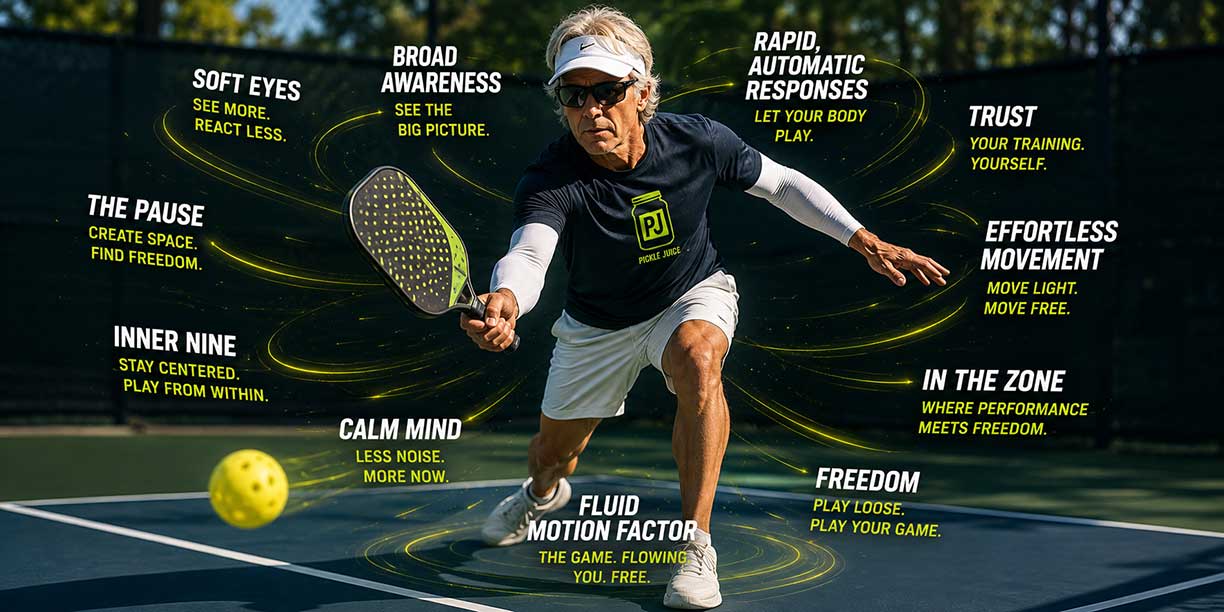
Fluid Motion Factor points in a different direction. Instead of focusing on controlling performance, it emphasizes accessing performance. Instead of adding more conscious supervision, it encourages less. The destination is not greater control but greater freedom. The goal is a state characterized by calm awareness, broad court vision, rapid automatic responses, and the sense that the game is unfolding naturally rather than being forced. Every athlete who has experienced "the zone" has encountered some version of this state.
The difficulty is that old habits do not disappear simply because we recognize them. The prefrontal cortex, which has spent years attempting to manage athletic performance, does not easily surrender its authority. It wants to help. It wants to anticipate problems, plan solutions, avoid mistakes, and improve outcomes. Sometimes it becomes so eager to contribute that it attempts to supervise individual shots in real time. Ironically, this well-intentioned involvement often disrupts the very performance it is trying to improve.
This is why understanding FMF intellectually and living FMF on the court are two very different things. Most players grasp the concepts long before they embody them. Knowing that conscious control interferes is one thing. Actually releasing that control while serving at 10-10 in the third game is something else entirely.
Perhaps a better comparison is learning a language. When we begin studying a foreign language, we start with a handful of words and phrases. We think carefully before speaking. We make mistakes. We struggle with pronunciation. Progress often feels slow and awkward. Yet little by little the language becomes more familiar. Words connect into sentences. Sentences connect into conversations. Eventually we stop translating everything in our heads and begin speaking more naturally.
FMF develops in much the same way. At first, you may occasionally remember Soft Eyes. You may experiment with the Pause. You may catch brief glimpses of the Inner Nine. These early experiences are like learning your first phrases in a new language. They are encouraging, but they are not yet fluent.
As time passes, the concepts begin to connect. You recover from mistakes more quickly. You notice that your awareness expands during points. You find yourself trusting shots rather than forcing them. Moments of freedom appear more frequently and last a little longer. You are still learning, still practicing, still reverting to old habits now and then, but the language is beginning to feel more natural.
Of course, every language learner occasionally slips back into old patterns. You use the wrong word. You fall back on familiar expressions. You laugh at yourself and continue. FMF follows a similar path. Some days you feel wonderfully fluid. Other days you discover that your old habits are still alive and well. The tendency to analyze, tighten, control, and supervise can reappear without warning. This is not evidence of failure. It is evidence that change is occurring within a system that has spent years operating another way.
Over time, however, something remarkable begins to happen. The Pause becomes less of a technique and more of a natural experience. Soft Eyes become less of an exercise and more of a way of seeing. Trust becomes less frightening. Freedom becomes more familiar. You stop trying so hard to create fluidity and instead begin allowing it to emerge.
There may never be a moment when you can point to a particular day and say, "Now I am an FMF player." More often, the realization arrives quietly. You notice that you are no longer obsessing over every technical detail. You are no longer measuring every point against your expectations. You are no longer attempting to micromanage performance from the conscious mind. The direction of travel has changed.
That, perhaps, is the best way to understand Fluid Motion Factor. It is not a switch. It is not a trick. It is not a technique layered on top of your game. It is a gradual movement away from interference and toward trust, away from supervision and toward freedom, away from forcing and toward allowing.
And if you stay with the process long enough, you may discover that what once felt like a foreign language has become your native tongue. In FMF terms, you have become wonderfully fluid.



0 Comments