Short Answer
The pause in pickleball is a tiny moment of inner stillness before contact. It is not a dramatic delay or a mechanical hitch in the stroke. From the Fluid Motion Factor perspective, the pause gives the body a fraction of space to organize naturally. It helps players stop rushing, overthinking, steering, and forcing the shot. The cue is simple: wait, receive, then let the body respond.
The Pause Is Smaller Than It Sounds
When pickleball players hear the word “pause,” some imagine something theatrical.
A player at the kitchen line freezes like Hamlet with a paddle. The ball floats by. The partner looks concerned. Somewhere a referee considers whether there is a rule against excessive contemplation.
That is not the pause.
The pause is not a delay that makes you late. It is not standing still while the rally continues without you. It is not a pose, a freeze, or a little meditation retreat at the non-volley zone.
The pause is much smaller than that.
It is a moment of inner quiet just before contact, when the player stops rushing the shot and allows the body to meet the ball.
In the Fluid Motion Factor approach, the pause is one of the simplest ways to reduce interference from the thinking mind. It creates a small opening where timing, feel, balance, and touch can return.
The pause is not added to the stroke.
It removes panic from the stroke.
Why Players Rush the Ball
Many pickleball mistakes happen because the player is mentally early.
The ball is still coming, but the mind has already left for the result.
“Don’t miss.”
“Put it away.”
“Keep it low.”
“Hit the middle.”
“Don’t pop it up.”
“Please do not hit this ball into the net in front of witnesses.”
By the time contact happens, the player is not really receiving the ball. The player is trying to control the outcome before the ball has fully arrived.
That is rushing.
Rushing does not always look fast. Sometimes it looks stiff. Sometimes it looks cautious. Sometimes it looks like a little jab, poke, guide, or paddle-shaped apology.
But underneath, the same thing is happening: the thinking mind has jumped ahead of the body.
The pause brings the player back.
Not to the score.
Not to the last miss.
Not to the target.
To contact.
The Ball Has to Arrive First
This sounds obvious, but many players try to hit the ball before they have truly received it.
They decide too early.
Attack.
Dink.
Speed up.
Drop.
Roll.
Angle.
Winner.
Heroic act of minor public redemption.
The trouble is that the ball may not have agreed to this plan.
The height may be different. The speed may be different. The bounce may be different. Your balance may be different. Your opponent may have shifted. Your partner may be wandering through the point like a person looking for a misplaced sandwich.
The pause lets the ball declare itself.
You see it.
You receive it.
Then you respond.
That order matters.
A good pickleball shot is not just a decision imposed on a ball. It is a response to what the ball is actually doing.
The Pause Helps the Body Organize
From the Fluid Motion Factor perspective, the body is capable of making incredibly subtle adjustments.
Your eyes read the ball. Your feet adjust. Your paddle face changes by small degrees. Your hand senses pressure. Your balance shifts. Your timing emerges.
Much of that happens faster than verbal thought.
The thinking mind can set a broad intention, but it cannot micromanage every piece of contact in real time. When it tries, the movement often becomes stiff, rushed, or overcontrolled.
The pause gives the automatic systems room to work.
It can soften the grip.
It can steady the feet.
It can reduce the lunge.
It can keep the paddle from stabbing at the ball.
It can let the shot happen from timing instead of urgency.
That is why the pause is not passive. It is active readiness without mental clutter.
The Pause Is Especially Useful Under Pressure
Pressure tends to make players early.
At 2-2, you see the ball.
At 10-10, you see the score, the future, your partner’s face, your past athletic disappointments, and perhaps the entire history of Western civilization.
The ball gets buried under meaning.
That is when players rush. They want the point to be over. They want safety. They want certainty. They want the ball to behave, preferably after signing a written agreement.
The pause interrupts that rush.
It says:
Wait.
Receive.
Now.
A player who uses the pause does not become passive or slow. The player becomes less hijacked by the future.
This is why the pause is such a useful focus cue. It brings attention back to the only place the body can actually play: the moment of contact.
The Pause Works With Soft Eyes
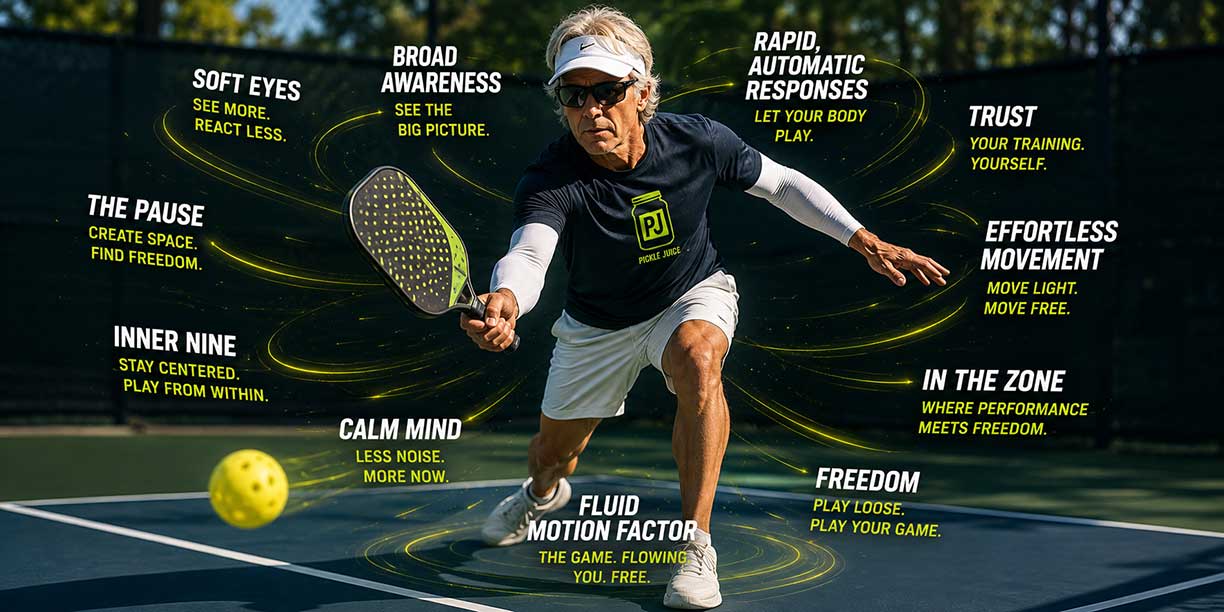
The pause works especially well with soft eyes.
Hard eyes tend to rush. They stare, clamp, and grab. The ball becomes a little yellow emergency.
Soft eyes allow the ball to arrive inside a wider field of awareness. You still see the ball clearly, but you also sense the court, the net, your partner, your opponents, and the space around the point.
This wider awareness makes the pause easier.
You are not pouncing on the ball.
You are receiving it.
The combination is simple:
Soft eyes. Pause. Contact.
That is not a complicated system, which is one reason it works.
The thinking mind enjoys elaborate systems. The body often prefers a clean doorway.
Where to Use the Pause
The pause can help almost anywhere in pickleball, but it is especially useful on shots where players tend to rush or steer.
Use it on dinks.
Use it on resets.
Use it on blocks.
Use it on third-shot drops.
Use it on returns.
Use it before serves.
Use it on easy put-aways, which are not always easy once the mind announces that they are easy.
On each of these shots, the cue is not “freeze.” The cue is “let the ball arrive.”
A dink with the pause feels less poked.
A reset with the pause feels less panicked.
A return with the pause feels less hurried.
A serve with the pause feels less forced.
An easy put-away with the pause feels less like a small criminal investigation.
The Pause Is Not the Same as Hesitation
This is an important distinction.
Hesitation is doubt.
The pause is readiness.
Hesitation says, “I don’t know what to do.”
The pause says, “Let me receive this fully.”
Hesitation tightens the body. The pause usually softens it.
Hesitation comes from fear. The pause comes from awareness.
To an outside observer, the difference may be subtle. But inside the player, it feels very different.
A hesitant player is late because the mind is stuck.
A pausing player is on time because the body is allowed to organize.
That is the little miracle. The pause can make you feel as if you have more time, even though the clock has not changed at all.
A Simple Practice Drill
You can practice the pause without making it complicated.
During warmup dinks, use this rhythm:
See. Pause. Touch.
Do not exaggerate it. Do not turn it into interpretive theater. Just notice a tiny settling before contact.
On resets, use:
Receive. Pause. Soften.
On serves, use:
Breathe. Pause. Swing.
On volleys, use:
Soft eyes. Pause. Meet.
The point is not to create a visible stop. The point is to feel less rushed inside the shot.
If the pause makes you late, you are probably making it too big.
Make it smaller.
Smaller still.
There it is.
The Pause Reduces Overthinking
Overthinking often happens because the mind is ahead of the body.
The player is already explaining, correcting, predicting, or judging before the ball has arrived.
The pause gives the mind one simple job.
Wait.
That is enough.
Not wait forever. Not wait passively. Not wait while the other team wins the point and your partner begins quietly reconsidering the partnership.
Just wait long enough to receive the ball.
In that small space, the body can take back some responsibility.
That is why the pause works so well with the broader FMF idea: better pickleball does not always come from more instruction. Often it comes from less interference.
The Pause and Flow
What many players call a flow state is the same condition the Fluid Motion Factor describes.
The body is moving naturally. The mind is quieter. Timing is better. Awareness is wider. The player is not forcing each shot through conscious control.
The pause helps create that condition.
It is one of the little doorways into FMF.
Not because the pause is magical, but because it gives the body access.
The player is not chasing flow. The player is creating one of the conditions that allows flow to appear.
Soft eyes.
Easy hands.
Acknowledge the ball.
Find the pause.
Let the body play.
That is the work.
Or perhaps better: that is how we stop working so hard in the wrong way.
A Simple Match Cue
If you want to use the pause in a match, do not give yourself a lecture.
Use one cue.
Pause.
Or:
Wait.
Or:
Receive.
That is enough.
Before the serve, feel the feet and pause.
At the kitchen, soften the eyes and pause.
After a mistake, breathe and pause before the next point.
When the ball comes, let it arrive.
The pause is not there to make you careful. It is there to make you available.
Available to the ball.
Available to timing.
Available to the body’s natural movement.
The Real Point of the Pause
The pause is simple, but it changes the relationship between the player and the ball.
Without the pause, many players attack the shot mentally before contact.
With the pause, the ball is allowed to arrive.
That tiny difference can change the grip, the timing, the touch, the breath, and the whole feeling of the point.
The pause is not a technique in the usual sense. It is a focus cue. It gives the player a way to stop rushing and return to the present shot.
The ball comes.
You see it.
You receive it.
There is a tiny moment of quiet.
Then the body responds.
That is the pause.
And sometimes, in pickleball, that little bit of nothing is exactly what allows something better to happen.
FAQ:
What is the pause in pickleball?
The pause is a tiny moment of inner stillness before contact. It helps the player stop rushing and allows the body to organize around the ball. It is not a visible freeze or delay. It is a small settling before the shot.
Does the pause make you late?
No, not if it is used correctly. The pause is very small. It should not interrupt the stroke or make you wait too long. It should help you receive the ball more clearly so the body can respond on time.
How is the pause different from hesitation?
Hesitation comes from doubt. The pause comes from readiness. Hesitation often tightens the body and makes the player late. The pause helps the player receive the ball, soften the grip, and let the body respond naturally.
What shots should I use the pause on?
The pause is useful on dinks, resets, blocks, third-shot drops, returns, serves, and easy put-aways. It is especially helpful on shots where players tend to rush, steer, jab, or overcontrol the paddle.
How do I practice the pause?
Practice during simple warmup dinks or resets. Use a small rhythm such as “see, pause, touch” or “receive, pause, soften.” Keep the pause tiny. The goal is not to stop the stroke, but to feel less rushed inside the shot.
Why does the pause help with focus?
The pause gives the thinking mind one simple job: wait long enough to receive the ball. That reduces overthinking, rushing, and interference. From the Fluid Motion Factor perspective, the pause helps the body regain access to timing, touch, and natural movement.


0 Comments