
Short Answer
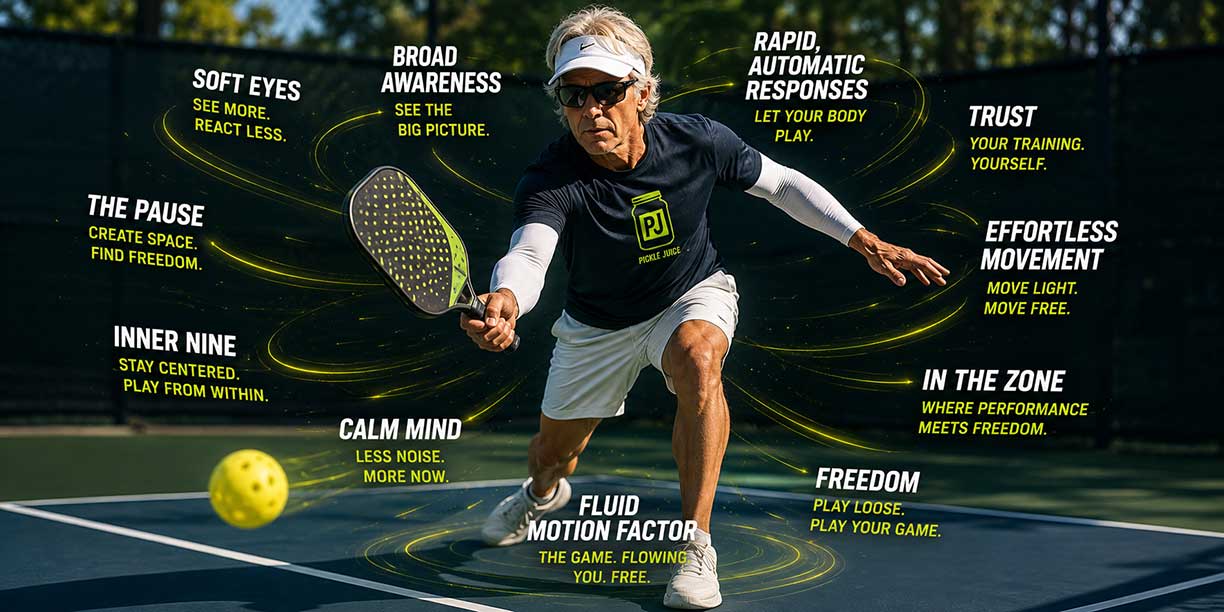
You get into a flow state in pickleball by entering the Fluid Motion Factor. They are not two separate things. A flow state is the common name for the same natural movement condition that FMF describes: the thinking mind stops interfering, and the body’s timing, balance, touch, vision, and instincts are allowed to work. The difference is that FMF gives players practical techniques to get there: soft eyes, acknowledging the ball, easy hands, the pause, and one simple cue.
Flow State Is FMF
Every pickleball player has had at least a few moments when the game suddenly feels easier.
The ball looks bigger. The court feels more open. Your feet seem to know where to go. Your paddle shows up on time. You are not late, not tight, not tangled in advice. You are not thinking about every piece of the shot. You are simply seeing, moving, and responding.
Most people call this a flow state.
In the Fluid Motion Factor system, we call it FMF.
These are not competing ideas.
They are two names for the same basic athletic condition.
Flow state describes how it feels. FMF explains what is happening and gives you ways to return to it.
In flow, the athlete feels absorbed, clear, responsive, and less self-conscious. In FMF, the body’s natural movement intelligence is operating without excessive interference from the conscious, supervisory mind.
That is the same event viewed from two angles.
Flow is the experience.
FMF is the mechanism and the method.
The Body Plays Better When the Mind Stops Supervising
Pickleball happens too quickly for the thinking mind to control everything.
The ball changes speed, height, spin, and direction. Your feet adjust. Your balance shifts. Your paddle face changes by tiny degrees. Your eyes gather information. Your hand manages touch. Your body decides whether to block, dink, drive, reset, roll, or get out of the way of a ball that has developed unfortunate ambitions.
The conscious mind cannot manage all of this in real time.
Fortunately, it does not have to.
Through practice and experience, the body learns. It predicts. It adjusts. It organizes movement faster than words can explain. When players enter flow, they are not becoming mindless. They are becoming less verbally controlled.
That is FMF.
The player is aware, but not overmanaging.
Focused, but not tight.
Responsive, but not rushed.
The body has been allowed back into the game.
Why Flow Disappears When You Try to Force It
One of the odd things about flow is that players often lose it as soon as they notice it.
You play three beautiful points in a row. The ball feels enormous. Your dinks float down politely. Your resets behave like trained birds. Then a thought appears:
“I’m really playing well.”
And just like that, the thinking mind walks back onto the court with a whistle and a clipboard.
Now you try to preserve the feeling.
You try to make sure you keep playing well.
You try not to lose it.
And in trying to hold flow, you interrupt it.
That is why the FMF approach is so useful. It does not tell you to chase flow directly. Chasing flow is usually a good way to scare it into the shrubbery.
FMF gives you physical and attentional tools that reduce interference.
You do not command flow.
You create the conditions for FMF.
And when FMF appears, that is flow.
Soft Eyes Are a Doorway Into Flow
One of the quickest ways to move into FMF is to soften your eyes.
Many players try to focus by staring harder. They clamp down visually. They narrow attention. They treat the ball as if it is a tiny yellow suspect under interrogation.
That kind of focus often creates tension.
Soft eyes are different.
Soft eyes allow you to see the ball clearly while also sensing the court around it: the net, the kitchen line, your partner, your opponents, the open space, and the rhythm of the point.
This wider awareness helps the body move naturally.
It also quiets the supervisory mind.
That is why soft eyes are not just a visual trick. They are a way of entering the same condition people call flow.
The court opens.
The body receives more information.
Movement becomes less forced.
FMF begins to appear.
Acknowledge the Ball
Another FMF technique for entering flow is to acknowledge the ball.
This phrase is important because it changes the quality of attention.
To acknowledge the ball is not to glare at it. It is not to attack it with your eyes. It is not to give yourself a lecture about what you should do with it.
It is simply to let the ball register.
You receive it into awareness.
This matters because under pressure, players often leave the ball mentally. They are still looking at it, perhaps, but their attention is really somewhere else.
The score.
The last miss.
The next point.
The partner’s reaction.
The fear of blowing it.
The hope of winning.
Now the ball has become a courtroom exhibit.
FMF brings attention back to the ball itself.
Not the story.
Not the consequence.
This ball.
When you acknowledge the ball, the body can organize around what is actually happening. That is flow. That is FMF.
Same thing.
Use One Cue, Not Seven
Flow does not happen in a crowded mind.
If you are giving yourself six mechanical instructions during a rally, the body is probably not moving freely. It is moving under supervision.
Keep the paddle up.
Bend your knees.
Watch the ball.
Don’t pop it up.
Hit through it.
Move your feet.
Don’t miss.
Stay calm.
Trust it.
Be natural.
At some point, the body needs a union representative.
FMF uses short cues because the body responds better to simple assignments.
Good cues include:
- Soft eyes.
- Smooth.
- Wait.
- Easy hands.
- Receive.
- See it.
- Let it happen.
The cue should not become a speech. It should point attention toward an experience.
A simple cue helps the mind step aside and lets the body play.
That is how FMF begins.
That is how flow begins.
Because they are the same condition.
Easy Hands Restore Feel
A tight grip is one of the quickest ways to fall out of flow.
When players get nervous or try too hard, they squeeze the paddle. The hand tightens. The wrist stiffens. The shoulder joins the meeting. Touch disappears.
A looser grip restores feel.
This is especially important on dinks, blocks, resets, drops, and soft volleys. But it matters on nearly every shot because the paddle cannot listen to the ball if the hand is shouting.
A useful FMF cue is:
Easy hands.
That phrase brings attention back to feel rather than force.
And feel is one of the main ingredients of flow.
When the hand softens, the body becomes more responsive. The paddle receives the ball instead of fighting it. Timing improves. Touch returns.
That is FMF showing up as flow.
The Pause Lets the Body Catch Up
Another practical FMF tool is the pause.
This is not a big theatrical pause. Nobody should be standing at the kitchen line like a bronze statue waiting for grant funding.
The pause is a tiny inner stillness before contact.
It is the moment when the player stops rushing, stops grabbing, and lets the body settle into the shot.
Many mistakes happen because the mind is early. The player is already thinking about the result before the paddle has met the ball.
The pause brings the player back to contact.
Wait.
Receive.
Now.
That small pause can soften the grip, steady the feet, widen the eyes, and let the paddle meet the ball instead of ambushing it.
This is one of the clearest bridges into FMF.
And since FMF is flow, the pause is also a way into flow.
Reset Quickly After Mistakes
Flow does not mean perfect play.
This is important because players sometimes imagine that if they are really in flow, they will stop missing. They will glide across the court like a minor household deity, placing every ball exactly where it belongs.
Unfortunately, pickleball remains pickleball.
You will still miss.
You will still misread a ball. You will still pop up a dink. You will still occasionally attack something that should have been left alone to think about its life choices.
The question is not whether you make mistakes.
The question is whether the mistake pulls you out of FMF.
A quick reset helps you return.
After a mistake:
- Breathe.
- Soften your eyes.
- Loosen your hand.
- Feel your feet.
- Return to the ball.
Do not hold a hearing.
Do not write a memoir.
Do not convert one missed dink into a theory of your athletic limitations.
Reset and return.
Flow continues not because mistakes disappear, but because the player does not keep feeding them.
You Cannot Force Flow, But You Can Practice FMF
This may be the most useful distinction.
You cannot force flow directly.
But you can practice FMF.
That means you can practice the conditions that allow flow to appear.
You can practice soft eyes during warmups.
You can practice acknowledging the ball during dinking.
You can practice easy hands on resets.
You can practice the pause before contact.
You can practice one simple cue instead of a page of instructions.
You can practice resetting after mistakes.
All of these are ways of training yourself to return to the same state most people call flow.
That is the practical advantage of FMF.
Flow is often talked about as something mysterious.
FMF makes it trainable.
Not perfectly controllable. Nothing in sports is.
But more available.
A Simple FMF Flow Routine
Here is a simple way to enter FMF, or flow, during pickleball:
Before the point:
Soften your eyes and feel your feet.
As the ball comes:
Acknowledge the ball.
Before contact:
Allow the pause.
During the shot:
Use one cue, such as “smooth,” “receive,” or “easy hands.”
After the point:
Reset physically before analyzing.
That is enough.
The goal is not to manufacture a special state through effort. The goal is to reduce interference so the natural state can emerge.
Flow is not something added on top of your game.
It is what your game feels like when the unnecessary clutter gets out of the way.
That is FMF.
Flow Is Not Magic. It Is Access.
The word flow can make the experience sound mystical. And yes, it can feel wonderful when it happens.
But from the FMF perspective, flow is not magic.
It is access.
Access to trained movement.
Access to timing.
Access to touch.
Access to wider vision.
Access to the body’s ability to respond without being micromanaged.
That is why FMF matters. It names the same experience athletes call flow, but it also explains why the experience appears and disappears.
When the thinking mind interferes, flow disappears.
When interference drops, FMF appears.
And when FMF appears, players usually say:
“I was in flow.”
They are right.
They just used the more familiar name.
The Real Secret: Flow State Is Fluid Motion Factor
So how do you get into a flow state in pickleball?
You enter the Fluid Motion Factor.
That is not a similar thing.
It is the same thing.
Flow state is the felt experience of FMF. FMF is the practical system that helps you get there.
The body sees more clearly.
The hand softens.
The mind quiets.
The ball is acknowledged.
The pause appears.
Movement becomes natural.
The game stops feeling like an argument with yourself and starts feeling like a point again.
That is flow.
That is FMF.
And the good news is that you do not have to wait for it like weather. You can practice the conditions that make it more likely.
Soft eyes.
Easy hands.
Acknowledge the ball.
Find the pause.
Use one cue.
Reset quickly.
Then let the body play.
FAQ:
1. What is a flow state in pickleball?
A flow state in pickleball is the same condition the Fluid Motion Factor describes. The thinking mind stops interfering, and the body’s timing, vision, touch, balance, and instincts work more naturally. The player feels clear, responsive, and less self-conscious.
Is flow state the same as Fluid Motion Factor?
Yes. Flow state and FMF describe the same athletic condition. Flow is the common term for the experience. Fluid Motion Factor is the practical explanation and training approach that helps players enter that state more often.
Can you force yourself into flow?
No. Trying to force flow usually brings the thinking mind back into control. But you can practice FMF techniques that make flow more likely, including soft eyes, acknowledging the ball, easy hands, the pause, and one simple cue.
Why do I lose flow when I notice I’m playing well?
You lose flow because noticing can turn into supervising. The thinking mind steps in and tries to preserve the good play. That extra control interferes with the natural movement that created flow in the first place.
What is the best cue for getting into flow?
Useful cues include “soft eyes,” “smooth,” “receive,” “wait,” and “easy hands.” The best cue is simple, physical, and uncluttered. It should help the body play instead of giving the mind more instructions to manage.
6. Does flow mean I will stop making mistakes?
No. Flow does not mean perfect play. It means freer, more natural play. You may still miss shots, but you recover more quickly because the mind does not turn every mistake into a crisis.


0 Comments