
Short Answer
Soft hands and soft eyes work together because both reduce tension and help the body receive the ball more naturally. Soft eyes widen awareness so you can see the ball, court, opponent, partner, and space without visual strain. Soft hands reduce grip pressure so the paddle can feel and respond to the ball. From the Fluid Motion Factor perspective, soft eyes help the body see the point, and soft hands help the body touch the point.
The Eyes and Hands Are Usually in the Same Mood
One of the odd little truths of pickleball is that the eyes and hands tend to travel together.
Hard eyes usually come with hard hands.
When a player is tense, the eyes narrow. The player stares at the ball as if it is withholding state secrets. The grip tightens. The paddle gets stiff. The shoulder joins in, because apparently everyone has to attend this meeting.
Now the player is not really receiving the ball.
The player is attacking the moment.
That is when soft shots become pokes, resets become shoves, dinks float up, and blocks rebound off the paddle like they have been evicted.
From the Fluid Motion Factor point of view, this is not just a technical problem. It is interference.
The thinking mind is trying to control the shot. The body gets tight. The eyes narrow. The hands clamp. Touch disappears.
Soft eyes and soft hands are two ways of reversing that pattern.
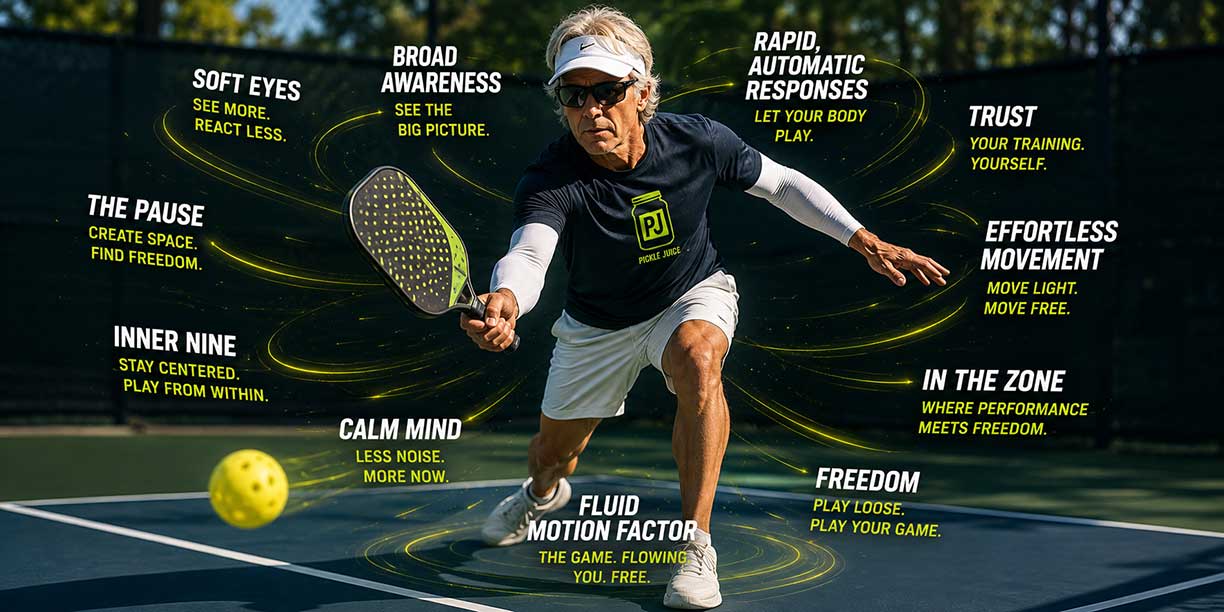
The eyes open the field.
The hands soften the contact.
Together, they help the body play with less strain and more feel.
Soft Eyes Help You Receive the Whole Point
Soft eyes do not mean sleepy eyes, lazy eyes, or vague eyes.
Soft eyes mean receptive eyes.
You still see the ball clearly, but you do not stare at it so hard that the rest of the court disappears. You allow the ball, paddle, net, opponent, partner, kitchen line, open space, and rhythm of the rally to exist in one wider field of awareness.
That wider awareness matters.
Pickleball is not just a ball game. It is a spacing game, a timing game, a pressure game, and occasionally a small neighborhood dispute over who had the middle.
When your eyes get hard, the world shrinks. You may see the ball, but you lose the context. You stop sensing where the opponent is leaning. You lose your partner’s movement. You miss the open space. You stop feeling the shape of the point.
Soft eyes let the court come back into view.
That gives the body better information.
And better information usually means less panic.
Soft Hands Help You Receive the Ball
Soft hands do not mean weak hands.
This is important.
A player with soft hands is not holding the paddle like a decorative napkin. The paddle is still supported. The hand is still alive. The wrist, arm, and shoulder are still connected.
But the grip is not clenched.
Soft hands allow the paddle to receive the ball instead of fighting it.
This matters especially on dinks, resets, blocks, drops, and soft volleys. On those shots, the paddle often needs to absorb, guide, cushion, or redirect. A tight hand turns those delicate adjustments into blunt instruments.
A tight grip makes the ball jump.
A softer grip lets the ball land.
From the FMF perspective, soft hands help restore feel. And feel is one of the body’s ways of knowing what to do before the thinking mind has finished explaining it.
Why They Work Better Together
Soft eyes without soft hands can still become overcontrol.
You may see the court well, but if your grip is strangling the paddle, the shot may still come off stiff.
Soft hands without soft eyes can become guesswork.
You may have touch, but if your visual attention is narrow or late, the body does not receive enough information to organize the shot.
Together, they complete the circuit.
Soft eyes receive the scene.
Soft hands receive the ball.
That combination helps create the conditions for the Fluid Motion Factor: less interference from the thinking mind and more access to the body’s timing, balance, touch, and natural response.
A useful way to think of it is this:
Soft eyes tell the body what is happening. Soft hands let the body answer.
The Problem With “Trying to Be Soft”
Of course, there is a trap.
A player can hear “soft hands” and immediately begin trying very hard to be soft.
This is how we get the strange pickleball contradiction of aggressive gentleness, which looks a little like someone trying to pet a cat while wearing oven mitts.
Softness cannot be forced.
If you try to manufacture softness with too much conscious control, the hand often becomes awkward. The player gets careful. The motion slows down unnaturally. The paddle face gets nervous.
The goal is not to perform softness.
The goal is to reduce the tension that blocks it.
That is why soft eyes come first for many players. When the eyes soften, the body often softens with them. The hand does not have to be instructed quite so loudly. It begins to loosen because the whole system is less alarmed.
Instead of telling yourself, “Be soft, be soft, be soft,” try:
Soft eyes. Easy hands.
That is enough.
Use Soft Eyes Before Contact
Soft eyes begin before the ball reaches you.
This is where many players get into trouble. They wait until contact to make the shot work, but by then the body may already be late, tight, or overloaded.
Soft eyes start earlier.
As the opponent prepares to hit, let your awareness widen. See the ball, but also sense the player’s paddle, body position, court spacing, and likely direction. As the ball travels, keep receiving the whole picture.
This does not mean analyzing everything.
It means allowing more information in.
The body is very good at using information that the verbal mind never needs to name.
A simple cue before contact:
Let the court come to you.
That cue prevents the eyes from grabbing and gives the body a wider map.
Use Soft Hands at Contact
Soft hands become especially important at the moment of contact.
This is where tension often shows itself.
The ball arrives, and the player squeezes.
That squeeze may be tiny, but it changes the shot. The paddle becomes less responsive. The ball jumps. The dink floats. The reset gets pushed. The block rebounds too far.
Instead, allow the hand to stay alive.
Not limp.
Alive.
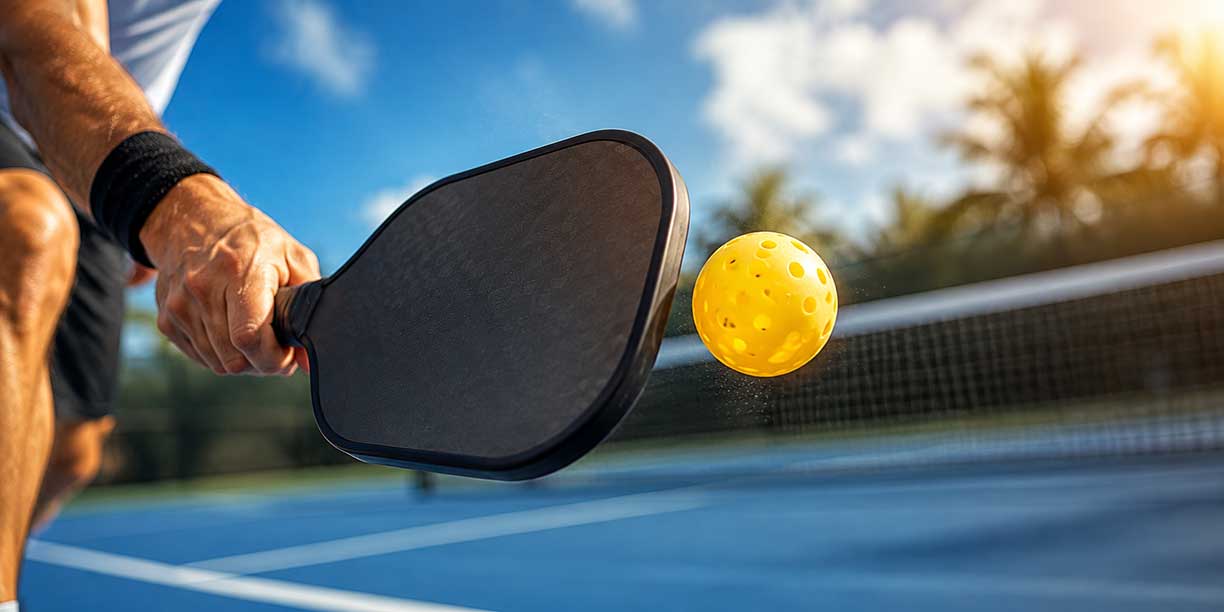
Feel the ball on the paddle for the smallest possible instant. Let the paddle meet the ball rather than punch at it. On softer shots, imagine that you are receiving the ball before sending it back.
A useful cue at contact:
Catch, then send.
Not literally, of course. Pickleball officials tend to frown on catching the ball with your paddle, along with several other things that would make the game much easier.
But as a feel cue, it works.
Receive first.
Respond second.
Soft Hands and Soft Eyes at the Kitchen
The kitchen line is where soft hands and soft eyes become especially useful.
The game gets faster there. The distances are shorter. The ball can change direction quickly. A dink can become a speed-up. A speed-up can become a block. A block can become a reset. A reset can become a small emotional weather event.
Hard eyes and hard hands make the kitchen feel chaotic.
Soft eyes help you see the whole exchange instead of reacting late to each separate ball.
Soft hands help you handle pace without turning every ball into a rebound.
Together, they make the kitchen feel less like a crisis and more like a conversation.
You are not lunging at the ball.
You are receiving the point.
Soft Hands and Soft Eyes on Resets
The reset may be the best test of this combination.
A reset requires both awareness and touch.
You need soft eyes to see the ball early, sense the court, and avoid panic. You need soft hands to absorb pace and keep the ball low.
If your eyes are hard, you may rush.
If your hands are hard, you may pop it up.
The reset asks for a quieter system.
A useful reset sequence is:
- Soft eyes.
- Easy hands.
- Pause.
- Receive.
- Lift softly.
This is not a mechanical checklist to recite during battle. It is a practice rhythm. In actual play, you may only use one cue:
Easy.
Or:
Receive.
The body can often do the rest.
Soft Hands and Soft Eyes Under Pressure
Pressure tends to harden everything.
The eyes narrow. The hand squeezes. The feet rush. The mind begins handing out instructions like a nervous substitute teacher.
At 9-9, the same dink that felt simple at 3-2 can suddenly feel as if it has been assigned constitutional significance.
That is when soft eyes and soft hands matter most.
Soft eyes keep the court from shrinking.
Soft hands keep the paddle from panicking.
Together, they remind the body that this is still just a ball.
Not a verdict.
Not a biography.
Not a referendum on whether you should have taken up bowling.
A ball.
See it.
Receive it.
Let the hand stay alive.
A Simple Drill for Soft Hands and Soft Eyes
Here is a simple drill.
Stand at the kitchen and dink crosscourt with a partner.
For the first minute, focus only on soft eyes. Let the court stay wide. See the ball without staring. Notice the net, partner, space, and rhythm.
For the second minute, focus only on soft hands. Loosen the grip. Let the paddle receive the ball. Feel the contact.
For the third minute, combine them with one cue:
Soft eyes, easy hands.
Do not try to be perfect. In fact, if you miss, use the miss as part of the drill. Reset. Soften. Continue.
The goal is not to win the dink drill. The goal is to train the body to recognize the feeling of receiving instead of forcing.
A Simple Match Cue
During a match, do not use a long explanation.
Use a short cue.
Soft eyes. Easy hands.
That is the main one.
You can also use:
See soft, touch soft.
Or:
Receive.
Or:
Let it land.
Pick one. The mind loves to collect cues the way a garage collects old paint cans. But one cue is usually plenty.
The point of a cue is not to give the brain more to manage. It is to help the body return to a simpler state.
The Real Goal: Receive Before You Act
Soft hands and soft eyes are really two parts of one larger idea:
Receive before you act.
Soft eyes receive the visual world.
Soft hands receive the physical contact.
When both are working, the player is less likely to rush, grab, poke, stare, steer, or overcontrol.
That does not mean every shot becomes perfect. Pickleball is still pickleball, a game in which the ball occasionally behaves like it was raised badly.
But the player becomes more available.
More responsive.
More connected.
Less trapped in the thinking mind.
That is the Fluid Motion Factor.
The eyes soften.
The hand softens.
The body listens.
And the ball has a better chance of going where it was invited.
FAQ:
What are soft hands in pickleball?
Soft hands mean using a relaxed, responsive grip so the paddle can receive the ball instead of fighting it. Soft hands are especially useful on dinks, drops, blocks, resets, and touch shots.
What are soft eyes in pickleball?
Soft eyes mean seeing the ball without staring too hard. You still see the ball clearly, but you also keep awareness of the court, net, partner, opponent, space, and rhythm of the point.
How do soft hands and soft eyes work together?
Soft eyes help you receive the whole court, while soft hands help you receive the ball at contact. Together, they reduce tension and help the body respond more naturally.
Are soft hands the same as a weak grip?
No. Soft hands do not mean limp hands. The paddle still needs support. The difference is that the grip is responsive rather than clenched. The hand is alive, not rigid.
When should I use soft hands and soft eyes?
Use them especially at the kitchen line, on dinks, resets, blocks, drops, and pressure points. They are also helpful whenever you feel rushed, tight, or overly mechanical.
What is a simple cue for soft hands and soft eyes?
A good cue is: soft eyes, easy hands. It is short enough to use during play and reminds the body to see broadly and touch lightly without turning the shot into a technical lecture.

0 Comments