Short Answer
Pickleball players choke under pressure because the thinking brain starts trying to control movements the body normally handles automatically. From the Fluid Motion Factor perspective, choking is not a character flaw or a lack of toughness. It is interference. The player begins managing, correcting, and judging in real time, which disrupts timing, touch, vision, rhythm, and natural movement.
The Strange Little Gremlin Called Pressure
Everybody who plays pickleball for more than about twenty minutes eventually meets the strange little gremlin known as pressure.
It usually appears at 9-9, or 10-10, or when you are serving for the game and suddenly the court seems to have changed dimensions. The kitchen line, which was perfectly visible all afternoon, now looks as if it has been moved by a committee. Your paddle feels either too light or too heavy. Your feet, which have been reasonably cooperative up to this point, begin acting like they are waiting for written instructions from headquarters.
And then comes the most familiar symptom of all.
You start thinking.
Not ordinary thinking. Not useful thinking. Not “they keep leaving the middle open” thinking. I mean the cramped, managerial, clipboard-carrying kind of thinking that tries to run the body from the top floor of the brain.
“Don’t miss this serve.”
“Keep your paddle up.”
“Don’t pop it up.”
“Bend your knees.”
“Watch the ball.”
“Please, for the love of all that is decent, do not hit this into the net.”
And, of course, into the net it goes.
This is what most players call choking. But from the Fluid Motion Factor point of view, choking is not proof that you “don’t have what it takes.” It is not a moral failure wrapped in a wiffle ball.
It is usually something much more specific and much more interesting.
It is interference.
Pressure Is Not the Real Problem
Pressure does not make you miss all by itself. In fact, pressure can sometimes sharpen performance. Good athletes often like pressure, not because they are made of some superior competitive alloy, but because pressure can bring energy, alertness, and intensity into the body.
The problem comes when pressure invites the wrong part of the brain to take over.
In ordinary play, the body can do a remarkable amount without conscious supervision. Your eyes, feet, hands, timing, balance, spacing, and paddle angle are all working together in a fast-moving little orchestra. Much of that coordination is happening below the level of verbal thought.
Your body is making tiny predictions and adjustments faster than the conscious mind could ever manage.
This is why you can sometimes play beautifully when you are not “trying” very hard. You see the ball. You move. You respond. The point unfolds. You are not absent, but you are not holding a faculty meeting in your head, either.
Then the score gets tight.
Suddenly the thinking mind, which is very useful for planning vacations, doing taxes, and remembering where you put the car keys, decides it should personally supervise your third-shot drop.
This is not always a good promotion.
Choking Happens When the Mind Starts Micromanaging
The conscious mind can make plans. It can notice patterns. It can set intentions. It can help you decide, between points, that the other team is vulnerable in the middle or that you are rushing your return.
But it is not built to micromanage contact with a ball arriving at court speed.
When it tries, the result is often stiffness, hesitation, overcorrection, or that awful little half-swing that feels as if it was designed by a nervous accountant.
This is why choking often feels so strange. You are not doing nothing. You are doing too much.
You are trying harder, caring more, concentrating more, instructing more, and somehow playing worse.
From the Fluid Motion Factor perspective, that is the key. The body’s natural movement system has been interrupted by too much conscious control.
The player has not lost ability.
The player has lost access.
Choking Is Often Trying Too Hard
The usual advice is to “focus more.” That sounds reasonable, but it can be exactly backward.
Many players choke not because they lack focus, but because they focus in the wrong way. They narrow down. They strain. They stare. They start monitoring mechanics. They attempt to guarantee the outcome by consciously controlling the movement.
That is when the swing loses its innocence.
You see this especially on serves, returns, and easy put-aways. The hard shot, oddly enough, may not bother us as much, because the body has to react. But give a player a floating ball at 10-10, with three acres of open court, and the mind suddenly walks in wearing a whistle.
“Here is a very easy shot,” it says. “Let’s make absolutely sure we do not miss it.”
This is the beginning of the crime scene.
The body knows how to hit the ball. But the mind wants a guarantee. And because there are no guarantees in sports, the mind starts adding effort, caution, and commentary. The shot that needed rhythm gets management. The movement that needed trust gets inspection.
In some ways, choking is not a collapse of effort.
It is an excess of effort applied at the wrong level.
The Ball Does Not Need a Speech
One of the central ideas in the Fluid Motion Factor approach is that players often confuse watching the ball with attacking the ball visually.
They stare at it. They clamp down on it. They try to “track” it with anxious intensity, as if visual strain were the same thing as awareness.
FMF uses a different phrase:
Acknowledge the ball.
That may sound almost too simple, but it changes the quality of attention.
To acknowledge the ball is not to glare at it. It is not to photograph it with your eyeballs. It is to receive it into awareness. You let the ball register. You allow the body to organize around it.
You are attentive, but not tight.
This is especially important under pressure because pressure tends to shrink the player’s world. The score gets loud. The consequences get loud. The imagined embarrassment gets loud. The mind begins dragging the future onto the court.
But the body does not play in the future.
It plays this ball.
Not the last miss. Not the next handshake. Not what your partner will think if you dump another return into the net.
This ball.
The more completely the player returns to the ball, the less room there is for the panic committee.
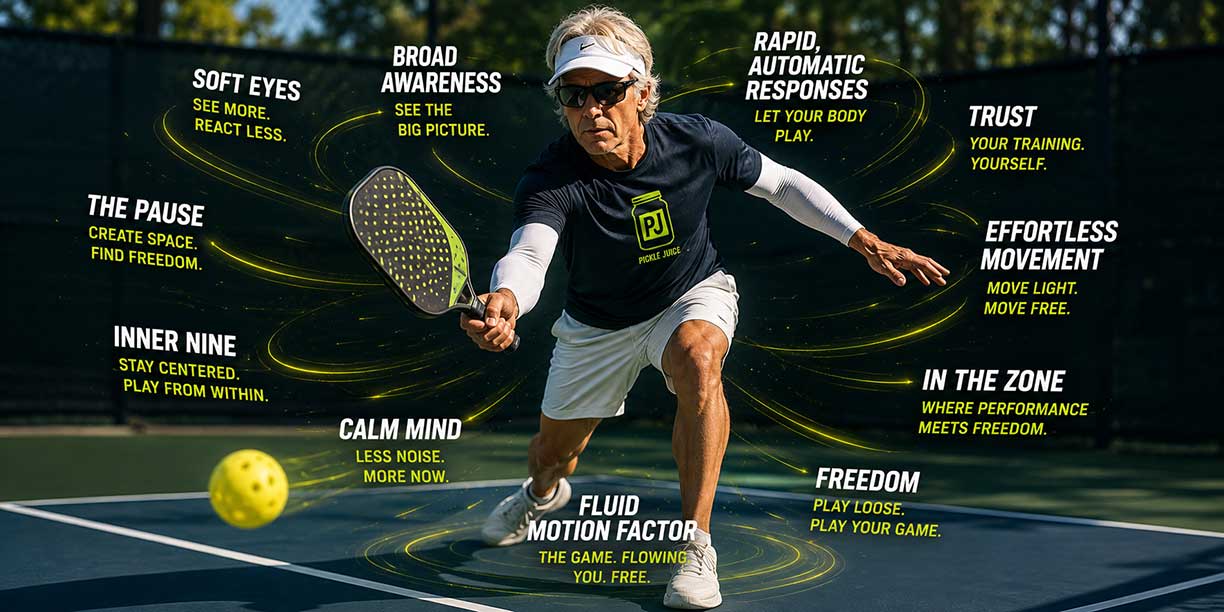
Soft Eyes Help Restore the Court
Another way players choke is by losing the court.
Under pressure, attention often becomes narrow and hard. The player sees the ball, but not the space. Or sees the opponent, but not the rhythm. Or sees the target, but not the pathway. The whole game becomes a series of little emergency decisions.
Soft eyes help because they widen awareness.
Soft eyes do not mean lazy eyes or unfocused eyes. They mean a broader, quieter kind of seeing. Instead of clamping attention onto one object, you allow the ball, paddle, opponent, net, kitchen line, and open space to exist in one field.
The court becomes less chopped up. The body has more information. Movement becomes less forced.
This matters because choking is often accompanied by the feeling that the court has become smaller. The net is taller. The sidelines are closer. The opponents are everywhere. Your own partner seems to be standing inside your rib cage.
Soft eyes help restore proportion. They give the nervous system a wider map.
And when the map improves, the body often stops acting lost.
The Pause Before Contact
One of the most useful FMF tools under pressure is the pause.
This is not a big theatrical pause. Nobody should be standing at the kitchen line in a Shakespearean trance while the ball goes by. It is a micro-pause, a moment of inner quiet before contact, when the player stops rushing the hit and allows the body to settle into the shot.
Many errors under pressure are not caused by bad technique in the usual sense. They are caused by being early mentally.
The player is already at the result before the paddle has met the ball. The mind has jumped ahead to winning, losing, explaining, apologizing, or surviving.
The pause brings the player back to contact.
That tiny stillness can soften the grip. It can reduce the lunge. It can let the paddle meet the ball instead of ambushing it. It can give the body just enough room to do what it already knows how to do.
In a funny way, the pause is not an addition to the stroke.
It is the removal of panic from the stroke.
What To Do When You Feel Yourself Choking
The usual temptation is to fix the whole self at once.
This is understandable but not helpful.
A player misses at 9-9 and immediately begins writing a five-volume biography of the error.
“I always do this.”
“I can’t close games.”
“My backhand is terrible.”
“I need a lesson.”
“I need a new paddle.”
“I need to become a different person by Tuesday.”
No.
The FMF approach is smaller and more physical.
First, notice the interference. Do not dramatize it. Just notice: “I’m trying to control this.”
Second, soften your visual attention. Let the court widen again.
Third, acknowledge the ball. Not the score. Not the story. The ball.
Fourth, allow the pause before contact. Give the body a beat of permission.
Fifth, choose one simple intention. Not six mechanical commands. One cue. Something like:
- Soft
- Through
- Middle
- Height
- Wait
- Smooth
- See it.
The simpler the cue, the better. Under pressure, the brain does not need a lecture. It needs a doorway.
Why This Is Different From Ordinary Mental Toughness Advice
There is nothing wrong with confidence, positive self-talk, routines, breathing, or staying present. These can all help.
But they often describe the desired state rather than the actual mechanism.
“Be confident” is lovely advice, in the same way “be taller” is lovely advice.
The Fluid Motion Factor looks at the problem differently. It asks what is interfering with natural movement. It looks at how the conscious mind can disrupt the body’s automatic systems. It treats pressure not as a mysterious test of willpower, but as a situation in which attention, timing, and trust can either narrow or open.
That distinction matters.
If a player believes choking means “I am weak,” the solution becomes self-judgment.
If the player understands choking as interference, the solution becomes practical:
Quiet the supervisor.
Soften the eyes.
Return to the ball.
Allow the body to play.
That is a much better assignment.
The Goal Is Not to Become Fearless
Pressure may never disappear. Frankly, it probably should not. A close game is supposed to feel different from casual dinking before lunch. The pulse rises. The hands notice the moment. The scoreboard starts speaking in a slightly louder voice.
The goal is not to feel nothing.
The goal is to keep pressure from turning into conscious control.
Good pickleball under pressure is not frantic. It is not limp. It has energy, but the energy is organized. The player is alert, but not clenched. Focused, but not narrow. Competitive, but not desperate.
The best players do not avoid pressure by becoming machines. They handle pressure by staying available to the shot in front of them.
That may be the simplest way to think about it.
Choking happens when the mind tries to seize the game.
Fluid motion returns when the player lets the body rejoin it.
So the next time the score gets tight and the little gremlin appears, don’t argue with it. Don’t give it a clipboard. Don’t let it conduct a seminar on your serve.
Soften your eyes.
Acknowledge the ball.
Find the pause.
Then play the point that is actually happening
FAQ:
What does it mean to choke in pickleball?
Choking in pickleball means that pressure causes a player to interfere with movements that normally happen naturally. The player may tighten up, overthink, rush, steer the ball, or try to consciously control a shot that the body usually knows how to make.
Why do I miss easy shots under pressure?
Easy shots often create extra pressure because the mind believes they “should” be made. That expectation can lead to steering, gripping, rushing, or overcontrolling the paddle. The shot may be easy physically, but mentally it becomes crowded.
How can I stop choking at 9-9 or 10-10?
Use a simple physical reset: soften your eyes, loosen your grip, take one easy breath, acknowledge the ball, and allow a small pause before contact. Or just pick one (do not give yourself a long list of technical instructions).
Is choking a mental toughness problem?
Not necessarily. From the Fluid Motion Factor perspective, choking is less about weakness and more about interference. The thinking mind starts supervising the body too much, which disrupts timing, touch, balance, and natural movement.
What should I focus on under pressure?
Focus on the ball and the field of play, not the score or the consequence. FMF uses the phrase “acknowledge the ball” because it encourages awareness without visual strain or mental overcontrol.
Do soft eyes help with pressure?
Yes. Soft eyes help widen awareness and reduce the tight, narrow focus that often appears under pressure. When the player sees the ball, court, space, opponent, and rhythm more broadly, the body has more useful information and can move more naturally.


0 Comments