Short Answer
To stay calm during pickleball matches, stop trying to force calmness with your thinking mind. From the Fluid Motion Factor perspective, calm comes from returning the body to the present point: soften your eyes, loosen your grip, feel your feet, acknowledge the ball, and use one simple cue. The goal is not to feel nothing. The goal is to keep pressure from turning into tension, overthinking, and interference.
Calm Is Not Something You Can Yell Into Existence
Every pickleball player has had the experience of trying to calm down by issuing a stern internal memo.
“Relax.”
“Calm down.”
“Don’t tighten up.”
“Just play.”
This sounds reasonable, except that the part of the mind giving these instructions is often the very part causing the trouble. It is like hiring a raccoon to guard the picnic basket and then wondering why the potato salad has vanished.
In a close match, the thinking brain likes to become very important. It starts supervising your serve, reviewing your last miss, predicting the score, monitoring your partner’s mood, and quietly preparing a closing argument in case things go badly.
This is what most players experience as pressure.
But from the Fluid Motion Factor point of view, the real problem is not pressure itself. The real problem is interference. The thinking mind begins to step into movements the body can usually handle more naturally.
The body knows more than we give it credit for.
It knows timing. It knows balance. It knows touch. It knows how to adjust the paddle face by tiny degrees. It knows how to respond before the verbal mind has finished printing the agenda.
Calmness, then, is not just an emotional state. It is a condition in which the body is allowed to play without being crowded by commentary.
The Goal Is Not to Remove Pressure
Many players assume they should try to get rid of pressure.
That would be nice, of course. It would also be nice if every third-shot drop floated perfectly into the kitchen while birds arranged themselves into a tasteful little formation overhead.
But pressure is part of competition.
A close game is supposed to feel different from casual dinking before lunch. The pulse rises. The hands notice the moment. The score begins to speak in a slightly louder voice. None of this means something has gone wrong.
The goal is not to remove pressure.
The goal is to keep pressure from turning into conscious control.
Pressure becomes a problem when it makes you start steering the ball, gripping the paddle, rushing the shot, staring too hard, or trying to manage six technical instructions at once.
That is when the body starts to feel less like an athlete and more like a committee.
Staying calm does not mean becoming emotionally flat. It means staying available to the ball in front of you.
Start With the Body, Not the Pep Talk
Many players try to stay calm by thinking calm thoughts.
Sometimes that helps. But in pickleball, calm has to reach the body quickly. A beautiful affirmation is not worth much if your paddle grip is squeezing the handle as if it owes you money.
So begin physically.
Take one easy breath.
Let your shoulders drop.
Loosen your grip.
Feel your feet on the court.
Let your eyes soften.
These are small things, but they tell the nervous system that the last point is over and the next point is here.
From the FMF perspective, this matters because tension is not just a feeling. Tension changes movement.
A tight hand changes touch.
A tight shoulder changes timing.
A tight jaw changes breathing.
A tight mind narrows vision.
If you want to stay calm, do not begin by arguing with yourself. Begin by giving your body the conditions in which calm is more likely to return.
Soft Eyes Lower the Temperature
One of the quickest ways pressure shows up is in the eyes.
Players start staring. They clamp down on the ball visually. They try to “watch the ball” with such grim determination that the rest of the court disappears.
This can feel like focus, but it often becomes strain.
Soft eyes are different.
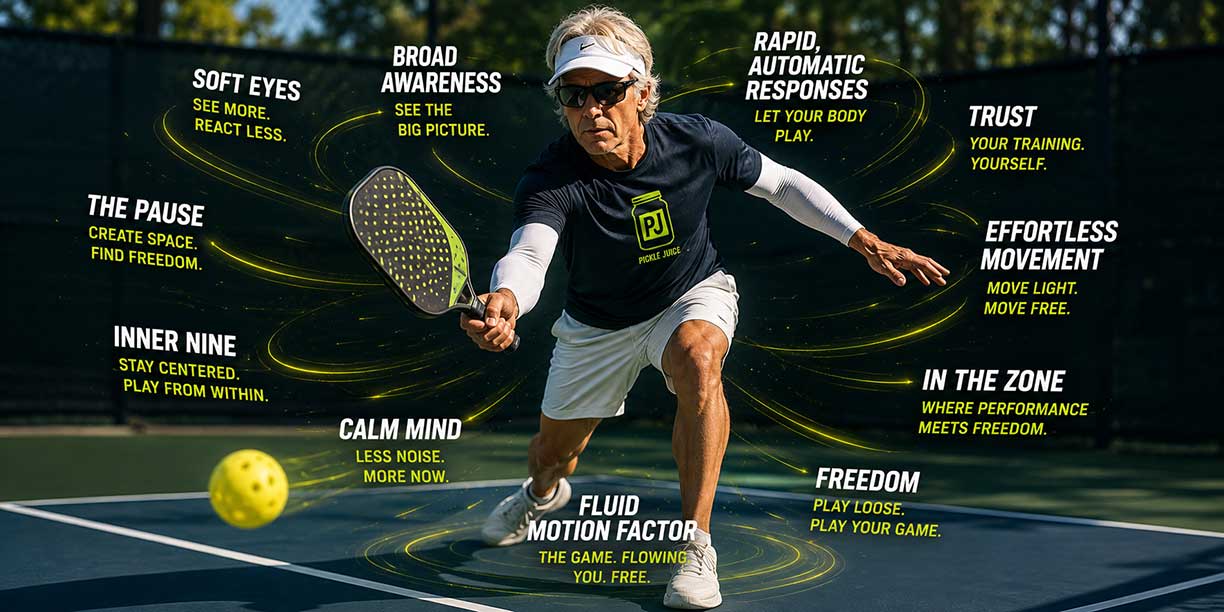
Soft eyes do not mean vague eyes. They mean receptive eyes. You still see the ball, but you also allow the court, your partner, your opponents, the net, the kitchen line, and the open space to remain in awareness.
In other words, the visual field widens.
This matters because panic tends to shrink the world. When the score gets tight, the court can feel smaller. The net looks taller. The opponents appear larger. The open space begins hiding somewhere behind the furniture.
Soft eyes help restore proportion.
They allow the body to receive more information without the thinking brain having to chase every detail with a clipboard.
In FMF language, soft eyes help the player return to the whole event, not just the emergency.
Acknowledge the Ball
The ball does not need a speech.
It does not need a lecture, a warning, a biography, or a desperate visual interrogation.
It needs to be acknowledged.
That phrase matters.
To acknowledge the ball is not to glare at it. It is not to attack it with your eyes. It is to let the ball register clearly, simply, and fully. You receive it into awareness.
This is especially useful when the match gets tense.
Under pressure, the mind often moves away from the ball and toward the meaning of the ball.
“If I miss this, we lose.”
“If I win this point, we’re back in it.”
“My partner is going to be upset.”
“I always mess up at this score.”
Now the ball has become a referendum.
That is a lot of pressure for one small yellow object with holes in it.
Acknowledge the ball instead.
Not the score.
Not the imagined future.
Not the memory of the last mistake.
This ball.
When attention returns to the ball, the body has a chance to organize itself again.
Use One Cue, Not Six Instructions
A common mistake under pressure is to over-coach yourself.
“Keep the paddle up.”
“Bend your knees.”
“Don’t pop it up.”
“Watch the ball.”
“Move your feet.”
“Don’t miss.”
This is too much.
It may all be technically reasonable, but it is not playable as a thought during a rally. The body cannot move freely while the mind is throwing tennis balls full of advice at it.
Use one cue instead.
Something simple:
- Soft eyes.
- Easy hands.
- See it.
- Wait.
- Smooth.
- Receive.
- Next ball.
The cue should not become a full instruction manual. It should point your attention toward a useful state.
“Easy hands” can soften the grip.
“Wait” can reduce rushing.
“Soft eyes” can widen vision.
“Receive” can keep you from deciding too early.
A good cue is not a command. It is a doorway.
Do Not Try to Win the Match During One Point
Many players lose calm because they make a single point too large.
At 9-9, one serve becomes the whole match. One return becomes proof of character. One dink becomes a small courtroom where your entire athletic history is being tried before an impatient jury.
This is not helpful.
A point matters, yes. But it is still just one point.
The body plays better when the task is small and immediate.
See the ball.
Move.
Receive.
Respond.
That is enough.
The mind wants to make the point symbolic. The body wants to play it.
Let the body have the smaller, better assignment.
Reset After Every Point
Calm players are not calm because nothing bothers them. They are calm because they return more quickly.
Every point leaves a little residue. A missed return. A lucky net cord. A partner’s mistake. A bad call. A terrible decision to speed up a ball that clearly had no interest in being sped up.
If that residue stays in the body, it becomes tension.
So build a reset.
After each point:
- Breathe.
- Loosen the hand.
- Soften the eyes.
- Feel the feet.
- Use one cue.
That may sound almost too simple, which is why people sometimes skip it. They want the dramatic solution, the secret lever, the hidden mental trick kept in a velvet pouch by tournament professionals.
But the nervous system likes consistency.
If you practice the same small reset after ordinary points, you have something familiar to return to when the score gets tight.
Calm Also Helps Your Partner
In doubles, your calm is not yours alone.
It spreads.
So does your panic, of course. Panic is very generous that way.
If you groan after every miss, slap your paddle, explain the point while walking back to serve, or radiate despair like a small weather system, your partner will feel it. Even if you say nothing, your body is communicating.
A calm reset tells your partner:
I am back.
I am here.
We can play the next ball.
That does not require false cheerfulness. You do not need to become a motivational poster wearing court shoes. A paddle tap, a breath, a nod, and one useful cue are usually enough.
In doubles, steadiness is a gift.
Give it freely.
Calm Is Not Passive
Some players worry that staying calm means losing intensity.
That is not what FMF means.
Calm does not mean sleepy. It does not mean casual. It does not mean you stop competing. It means your energy is organized instead of scattered.
A calm player can still be alert, aggressive, decisive, and fully engaged.
The difference is that the calm player is not fighting the moment.
The player is not arguing with the last point, fearing the next point, or trying to manually operate every part of the stroke. The player is present enough to let the body respond.
That is not passivity.
That is availability.
The Real Secret: Return to the Ball
Staying calm during pickleball matches is not mainly about becoming a different kind of person.
It is about returning.
Return to the breath.
Return to the feet.
Return to soft eyes.
Return to the paddle in your hand.
Return to your partner.
Return to the ball.
Not the last mistake.
Not the future score.
Not the imaginary speech you will give yourself in the car.
This ball.
This court.
This point.
That is where calm begins.
FAQ:
Why do I get nervous during pickleball matches?
You get nervous because the score, your partner, your opponents, and your own expectations can make the point feel bigger than it is. From the Fluid Motion Factor perspective, nervousness becomes a problem when it causes the thinking mind to interfere with natural movement.
What is the quickest way to calm down during a match?
The quickest way is physical: take one easy breath, loosen your grip, soften your eyes, and feel your feet. This helps your nervous system return to the present point instead of carrying tension from the last one.
Should I use positive self-talk during pickleball?
Positive self-talk can help, but it should be short and simple. Long speeches often create more mental clutter. A cue like “soft eyes,” “easy hands,” “wait,” or “next ball” is usually more useful than a full motivational address.
How do soft eyes help me stay calm?
Soft eyes widen your awareness. Instead of staring tensely at the ball, you allow the whole court to remain present. This reduces visual strain, helps the body receive more information, and keeps pressure from narrowing your focus too much.
5. How do I stop tightening up in close games?
Do not try to fix everything at once. Loosen your grip, breathe, soften your shoulders, and use one cue before the next point. Tightness often comes from trying to control the outcome. Calm returns when attention comes back to the ball.
Is staying calm the same as not caring?
No. Staying calm does not mean you care less. It means your energy is organized. You can still compete hard, but without letting pressure turn into tension, rushing, overthinking, or conscious control.


0 Comments