Short Answer
To play more naturally in pickleball, stop trying to consciously control every shot. From the Fluid Motion Factor perspective, natural play comes when the body is allowed to use its built-in timing, balance, vision, feel, and coordination without constant interference from the thinking mind. Soften your eyes, loosen your grip, acknowledge the ball, use one simple cue, and let the body respond.
Natural Play Is Not Careless Play
Every pickleball player has had one of those points where the game suddenly feels easy.
The ball comes. You move. The paddle is there. The shot goes where it should. You did not give yourself seven instructions, hold a board meeting, or ask your prefrontal cortex to issue a formal ruling on paddle angle.
You just played.
Then, naturally, you notice that you are playing well.
This is often where the trouble begins.
The mind wakes up, straightens its tie, and says, “Excellent. I’ll take it from here.”
And within three shots you have dumped a dink into the net, overhit a return, or tried a speed-up that had all the strategic elegance of throwing a toaster into a canoe.
This is the strange problem of natural play. It often appears when we stop trying so hard, and it often disappears when we try to capture it.
From the Fluid Motion Factor perspective, natural pickleball is not random, lazy, or untrained. It is organized movement without unnecessary interference.
The body is still working.
It is just not being heckled from the balcony.
The Body Knows More Than the Mind Can Say
Pickleball moves quickly. Even at recreational speeds, there is a lot happening at once.
The ball has speed, height, spin, depth, and direction. Your feet have to adjust. Your paddle face has to change. Your balance has to shift. Your eyes have to gather information. Your hand has to manage touch. Your body has to decide whether to block, dink, drive, reset, volley, or get out of the way of a ball that clearly has plans of its own.
The conscious mind cannot calculate all of this in real time.
Fortunately, it does not have to.
Through practice and experience, the body learns patterns. It predicts. It adjusts. It organizes movement faster than verbal thought can explain. This does not mean technique is irrelevant. Technique matters. Practice matters. Good instruction matters.
But during play, the goal is not to recite technique.
The goal is to access it.
That is where many players get into trouble. They learn useful things, then try to consciously apply all of them during every shot. Their mind becomes a crowded garage sale of tips.
Keep the paddle up.
Bend the knees.
Watch the ball.
Move your feet.
Don’t pop it up.
Hit to the backhand.
Stay loose.
Be aggressive.
Don’t be too aggressive.
Maybe become an entirely different person by Thursday.
No body can play freely under that much supervision.
Natural Movement Needs a Clear Assignment
The Fluid Motion Factor approach does not say, “Don’t think.” That would be both impossible and inconvenient, especially if someone asks the score.
Instead, FMF asks the thinking mind to do the right job at the right time.
Before the point, you can set a simple intention.
During the point, you receive the ball.
After the point, you can notice what happened.
That order matters.
Problems begin when the mind tries to analyze, correct, predict, and judge while the ball is already arriving. That is like trying to rewrite the recipe while the pancake is in midair.
Natural play needs a cleaner assignment.
Not:
“Keep your paddle face slightly open, move your feet, watch the ball, don’t overhit, stay calm, make sure you get it deep, and don’t embarrass yourself in front of these people who supposedly came here for exercise.”
But:
“Receive.”
Or:
“Smooth.”
Or:
“Soft eyes.”
A simple cue gives the body direction without turning the mind into a nervous project manager.
Start With Soft Eyes
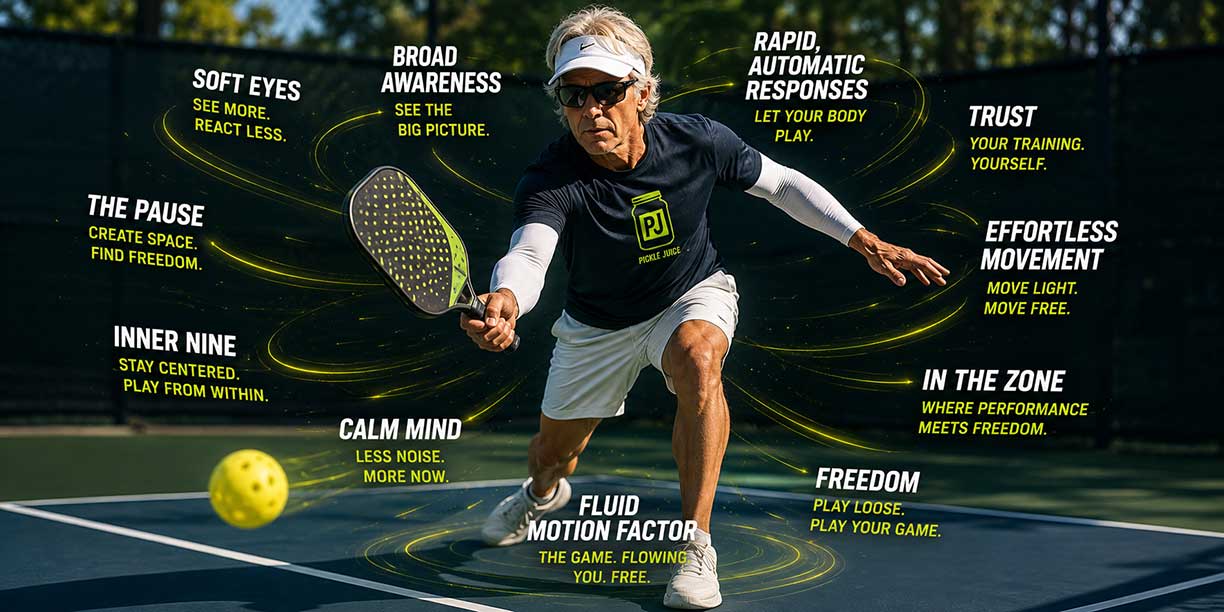
One of the best ways to play more naturally is to soften your eyes.
Many players try to “watch the ball” by staring harder. They narrow their vision. They clamp down on the ball. They turn visual attention into a kind of emergency searchlight.
This can make the body tighten.
Soft eyes are different.
Soft eyes allow you to see the ball clearly while still sensing the court around it. You are aware of the ball, but also the net, your partner, your opponents, the kitchen line, the open space, and the rhythm of the point.
Soft eyes do not mean vague eyes.
They mean receptive eyes.
A player with soft eyes often seems to have more time. Not because the ball is actually slower, but because the body is receiving information earlier and more broadly.
When the eyes soften, the body often softens with them.
And when the body softens, timing improves.
Acknowledge the Ball
Another useful FMF phrase is:
Acknowledge the ball.
This is different from staring at the ball. It is also different from attacking the ball with your mind.
To acknowledge the ball is to let it register.
You receive it into awareness.
You do not need to give the ball a speech. You do not need to remind it of your last miss. You do not need to explain to it that this is an important point and you would very much appreciate its cooperation.
You just see it.
This matters because many unnatural shots happen when the player is not really with the ball. The player is with the score, the target, the last mistake, the partner’s mood, or the imagined outcome.
The body plays this ball.
Not the ball you missed.
Not the ball you hope to hit next.
This ball.
Natural play begins when attention returns to what is actually happening.
Loosen the Grip and Let Touch Return
A tight grip is one of the first signs that the thinking mind has taken over.
Under pressure, players often squeeze the paddle as if they are trying to extract a confession from it. The hand tightens. The wrist stiffens. The shoulder joins the committee. Touch disappears.
A looser grip gives the body more options.
It allows the paddle to receive the ball instead of fighting it. It helps with dinks, resets, blocks, drops, and soft volleys. It also helps prevent the rushed, jerky movement that often comes from overcontrol.
This does not mean the paddle should flop around like a wet newspaper.
It means the hand should be alive, not clenched.
A useful cue is:
Easy hands.
That phrase brings the player back to feel.
And feel is one of the doorways to natural play.
Stop Trying to Guarantee the Result
One reason players stop playing naturally is that they want certainty.
They want to make sure the serve goes in.
Make sure the dink stays low.
Make sure the return is deep.
Make sure the put-away is not missed.
Make sure the partner does not look over with that small, devastating expression that says, “Interesting choice.”
The problem is that sports do not offer guarantees.
When the mind tries to guarantee a shot, it often adds tension. It steers. It checks. It guides the paddle through contact. It tries to control the future before the ball has even arrived.
Natural play requires a different kind of trust.
Not blind trust.
Not reckless trust.
Trained trust.
You give the body a clear intention, then allow it to perform the movement without excessive interference.
This is hard because the mind likes control. It feels useful when it is talking.
But in the middle of a point, the best thing the mind can often do is become quieter.
Use the Pause
The pause is one of the most practical ways to play more naturally.
This is not a big dramatic pause. Nobody should be standing at the kitchen line like Hamlet contemplating a third-shot drop while the ball sails past.
The pause is a tiny inner stillness before contact.
It is the moment when you stop rushing the hit and let the body settle into the shot. It can happen on a dink, a reset, a block, a return, or a serve.
Many mistakes happen because the player is mentally early. The mind has already jumped to the result before the paddle has met the ball.
The pause brings you back to contact.
It says:
Wait.
Receive.
Now.
That small moment can soften the grip, quiet the eyes, and allow the paddle to meet the ball instead of ambushing it.
Natural Play Can Be Practiced
Some people think natural play is just something that happens, like weather or finding a forgotten twenty-dollar bill in a jacket.
But natural play can be practiced.
You practice it by creating conditions where the body can organize itself.
During drills, use one cue instead of many.
During warmups, notice the feel of contact.
During dinking, practice soft eyes.
During serves, practice rhythm instead of force.
During games, reset after mistakes.
You are not practicing being casual. You are practicing access.
The body becomes more trustworthy when it is given repeated chances to operate without constant interruption.
This is why simple drills can be so valuable. A player who dinks quietly for five minutes while using soft eyes and easy hands may be training something deeper than technique.
They may be training the nervous system to stop treating every ball like an emergency.
Play the Point That Is Actually Happening
A great deal of unnatural pickleball comes from playing some other point.
The last point.
The next point.
The point you should have won.
The point you are afraid to lose.
The point your partner is still silently reviewing.
The point where you finally prove, beyond all reasonable doubt, that buying this paddle was justified.
But the body cannot play those points.
It can only play this one.
Natural play is a return to the present event: this ball, this bounce, this contact, this court, this partner, this opening.
That sounds simple because it is.
It is also difficult because the mind is a time traveler with bad boundaries.
FMF brings the player back to the ball in front of them.
A Simple System for Playing More Naturally
Here is a practical FMF-based system you can use immediately:
Before the point: soften your eyes and feel your feet.
As the ball comes: acknowledge the ball.
Before contact: allow a tiny pause.
During the shot: use one cue, such as “smooth,” “easy hands,” or “receive.”
After the point: reset physically before analyzing.
Between games: think lightly about patterns, but do not carry a full coaching manual into the next rally.
That is enough.
The purpose is not to become a mystical pickleball being who floats six inches above the court and never misses a dink.
The purpose is simpler: reduce interference and let trained movement come through.
Natural Does Not Mean Perfect
Playing naturally does not mean you will never miss.
You will miss.
Sometimes you will miss by a little. Sometimes you will miss by an amount that invites cartography.
That is fine.
Natural play is not perfect play. It is freer play.
A player who is playing naturally can miss and return quickly. A player who is overcontrolling often misses and then hires the mind to investigate, prosecute, appeal, and publish a memoir about the shot.
The difference is recovery.
When the body is allowed back into the game, mistakes do not have to become identities.
They are just events.
The ball was missed.
The next ball is coming.
That is pickleball. Also, regrettably, life.
The Real Goal: Less Interference, More Access
The goal of natural pickleball is not to turn off the mind.
It is to let the mind stop interfering with what the body already knows how to do.
The thinking mind can help you learn, plan, notice, and adjust. But during the point, it often needs to step aside enough for vision, timing, balance, touch, and response to work together.
That is the heart of the Fluid Motion Factor.
Not effortlessness because nothing is happening.
Effortlessness because the right things are happening without needless interruption.
So if you want to play more naturally in pickleball, begin with this:
Soften your eyes.
Loosen your grip.
Acknowledge the ball.
Find the pause.
Use one simple cue.
Then let the body play the point that is actually happening.
FAQ:
What does it mean to play naturally in pickleball?
Playing naturally means allowing your body’s timing, balance, vision, and feel to work without too much conscious interference. It does not mean playing carelessly. It means using your training without constantly trying to manage every part of the shot.
Why do I play worse when I try harder?
Trying harder often leads to tension, overcontrol, and too many internal instructions. The thinking mind starts supervising movements the body can usually handle more naturally. From the FMF perspective, the problem is not effort itself, but effort applied at the wrong level.
How do soft eyes help natural play?
Soft eyes widen your awareness. Instead of staring tightly at the ball, you see the ball while also sensing the court, partner, opponent, and open space. This helps the body organize movement more naturally and reduces the strain that comes from hard visual focus.
What is a good cue for playing more naturally?
Good cues include “soft eyes,” “easy hands,” “smooth,” “receive,” “wait,” and “let it happen.” The best cue is short, physical, and simple. It should guide attention without turning into a long technical checklist.
Does playing naturally mean ignoring technique?
No. Technique is important, especially in practice and instruction. But during a rally, the goal is to access technique, not recite it. Too much mechanical thinking during play can disrupt timing and touch.
How can I practice natural movement in pickleball?
Learn how to play more naturally in pickleball using the Fluid Motion Factor approach: soften your eyes, acknowledge the ball, loosen your grip, find the pause, and reduce mental interference.


0 Comments