
Short Answer
To reset after a bad point in pickleball, do not try to fix the mistake while the next point is already beginning. Take one easy breath, soften your eyes, loosen your grip, feel your feet, and return your attention to the next ball. From the Fluid Motion Factor perspective, the best reset is not a pep talk. It is a physical return to the body’s natural timing, balance, and awareness.
The Little Courtroom After a Bad Point
Every pickleball player knows the little courtroom drama that begins after a bad point.
You miss an easy dink. You pop up a reset. You serve into the net at 9-9, which is always a wonderful time to begin questioning every life decision that brought you to this sunny rectangle of judgment.
And then the mind arrives.
Not quietly, either.
It comes in wearing a whistle and carrying a clipboard.
Why did you do that?
You always miss that shot.
Keep your paddle up.
Move your feet.
Don’t blow this game.
What is wrong with you?
This is what many players call “losing focus,” but from the Fluid Motion Factor perspective, something more specific is happening. The thinking brain, especially the part that likes to supervise, criticize, and improve things in real time, has stepped into the middle of a movement system that works best when it is allowed to organize itself.
In other words, after a bad point, the problem is not only the mistake.
The problem is the meeting you hold about the mistake.
The Bad Point Is Over. Your Body Knows This. Your Mind May Not.
The ball is dead. The point is finished. The score has changed. Everyone is walking around, adjusting hats, retrieving balls, tapping paddles, and pretending to be emotionally stable.
But inside your head, the point may still be happening.
This is one of the odd things about sports. The body moves on quickly. The nervous system is ready for the next serve, the next return, the next pattern. But the verbal mind often drags the last point behind it like a bag of wet towels.
That lingering replay creates tension. And tension changes movement.
A tight hand changes touch.
A tight shoulder changes timing.
A tight jaw changes breathing.
A tight mind narrows vision.
So the first rule of resetting after a bad point is simple:
Do not try to fix the point that is already gone.
That does not mean you learn nothing. It means you do not conduct a full forensic investigation between points. Pickleball is not helped by bringing in a tiny courtroom stenographer.
A Real Reset Is Physical Before It Is Mental
Many players think a reset means saying something positive.
“Come on.”
“Next point.”
“You’ve got this.”
“Stay focused.”
That can be useful, but only if the body believes it. Otherwise it becomes a slogan pasted over a nervous system that is still buzzing like an old fluorescent light.
A real reset begins physically.
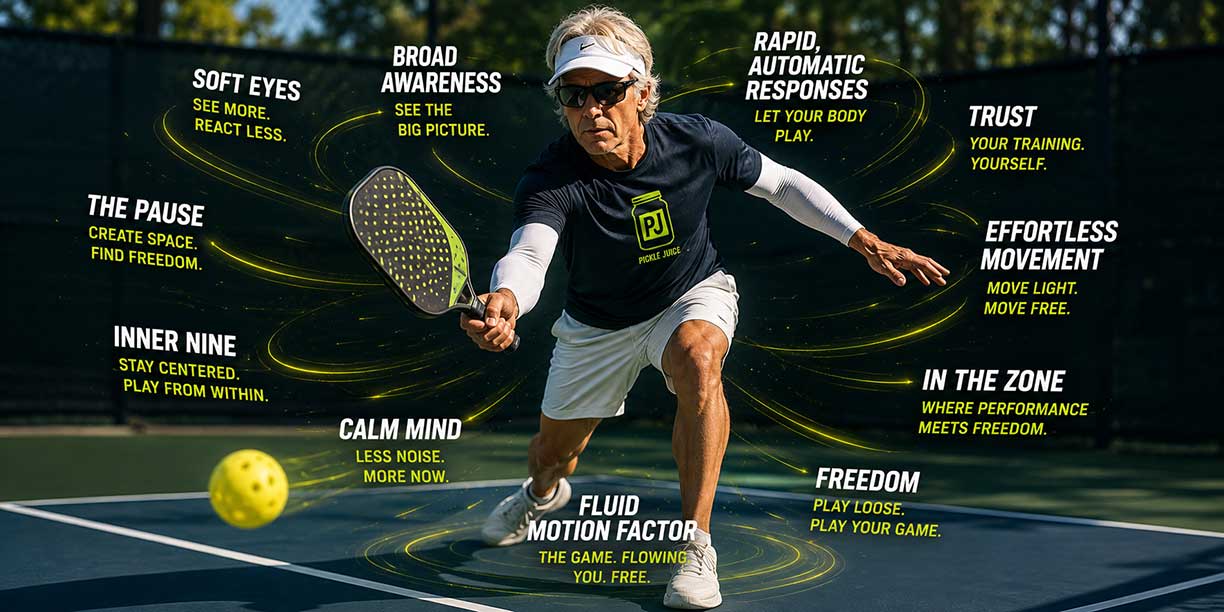
Take one easy breath. Let the shoulders drop. Feel your feet on the court. Loosen your grip. Let your eyes soften. Look at the ball without glaring at it. Let the court come back into view.
That little sequence matters because it tells the body, “We are no longer in the last point.”
From the Fluid Motion Factor point of view, this is not relaxation merely for the sake of feeling better. It is a way of returning control to the systems that actually produce good movement: timing, balance, visual awareness, touch, rhythm, and response.
The body cannot play freely while the mind is still scolding it.
Use a Small Cue, Not a Big Speech
After a bad point, you do not need a philosophy seminar. You need a small cue.
Something simple:
- Soft eyes.
- Easy hands.
- See it.
- Pause.
- Receive.
- Smooth.
- New ball.
The cue should be short enough that it does not turn into instruction. It should point your attention toward an experience, not a correction.
There is a big difference between these two thoughts:
“Don’t overhit the return, keep the paddle face closed, bend your knees, watch the ball, make sure you get it deep, and for heaven’s sake don’t do that thing again.”
And:
“Smooth.”
The first one clutters the dashboard. The second one gives the system a direction.
A good reset cue should feel less like a command and more like opening a window.
Let the Error Pass Through, Not Set Up Camp
A bad point often has a second life because we give it one.
We miss a shot, then we attach a story to it.
“I always choke.”
“My backhand is terrible.”
“I can’t play against bangers.”
“I’m letting my partner down.”
“I had this game and now it’s slipping away.”
Now one missed dink has become autobiography.
This is where players get into trouble. They do not just react to the point. They react to the meaning they have assigned to the point.
A better approach is to acknowledge the error without decorating it.
“Missed it.”
That is enough.
No sermon. No self-portrait. No tragic fiddle music.
Just notice it and return.
Practice the Reset Before You Need It
You cannot wait until 9-9-2 to invent emotional composure. That is a little late to begin building the cathedral.
A reset has to be practiced during ordinary games, ordinary drills, and ordinary missed shots. Especially ordinary missed shots. Those are the training ground.
Every time you miss, rehearse the same small return:
- Breathe.
- Soften the eyes.
- Loosen the hand.
- Feel the feet.
- Pick one simple cue.
- Play the next ball.
That is the whole system. It is not dramatic, which is one reason it works.
The nervous system likes consistency. If you give it the same little ritual after small mistakes, it has something familiar to return to after bigger mistakes.
Your Partner Also Needs Your Reset
There is another reason to reset quickly: your partner is standing right there.
In doubles, emotional weather spreads fast. One player misses a shot and suddenly both players are living under the same little thundercloud. A visible reset helps your partner relax, too.
A paddle tap can help. A nod can help. A calm “good idea” or “right play” can help.
But the most useful thing is not the words. It is the signal:
I am back. I am here. I am ready for the next ball.
That steadiness is contagious.
So is panic, of course. Pick the better infection.
Resetting Is Not Forgetting
Some players worry that if they let go of a mistake, they will keep repeating it. But resetting does not mean forgetting. It means postponing analysis until analysis can actually help.
Between points, you need presence.
After the game, you can think.
That is when you can ask useful questions:
Was I rushing the dink?
Was I too close to the kitchen line?
Was I trying to do too much with the return?
Was I aiming too fine?
Was I reacting to the last point instead of seeing the next ball?
Those are useful questions.
But they are not useful while the next serve is already coming.
The Real Goal: Return to the Ball
A reset after a bad point is not mainly about feeling confident. Confidence comes and goes. Some days it arrives early. Some days it gets lost in traffic.
The real goal is simpler.
Return to the ball.
Not the last ball.
Not the imagined future ball.
This ball.
See it. Receive it. Let the body respond.
That is the heart of a good reset. You are not trying to become a different person between points. You are not trying to erase the mistake from history. You are simply stepping out of the commentary booth and back onto the court.
The bad point happened.
Fine.
Now breathe, soften the eyes, loosen the hand, and let the next ball be new.
FAQ:
What is the fastest way to reset after a bad pickleball point?
The fastest reset is physical: take one easy breath, loosen your grip, soften your eyes, and feel your feet. This helps your body return to the present point instead of carrying tension from the last one.
Should I think about what went wrong after every missed shot?
Not during the match. You can make a simple note, but detailed analysis is usually better after the game. Between points, too much thinking can tighten your body and interfere with natural movement.
Why do I make more mistakes after one bad point?
One mistake often creates mental commentary, tension, and urgency. That tension changes your touch, timing, vision, and decision-making. The second mistake is often caused less by skill and more by the reaction to the first mistake.
What should I say to myself after a bad point?
Use a short cue, not a speech. Good examples include “soft eyes,” “easy hands,” “smooth,” “pause,” or “new ball.” The cue should bring you back to awareness, not give your brain more instructions to manage.
How can I help my doubles partner reset after a mistake?
Keep it simple. A paddle tap, a nod, or a calm “right idea” can help. The most important message is that you are steady, present, and ready for the next point. Do not add coaching unless your partner asks for it.
Is resetting the same as forgetting the mistake?
No. Resetting means letting go of the mistake during play so your body can perform freely. You can still learn from the mistake later, when analysis is useful instead of disruptive.


0 Comments