
Short Answer
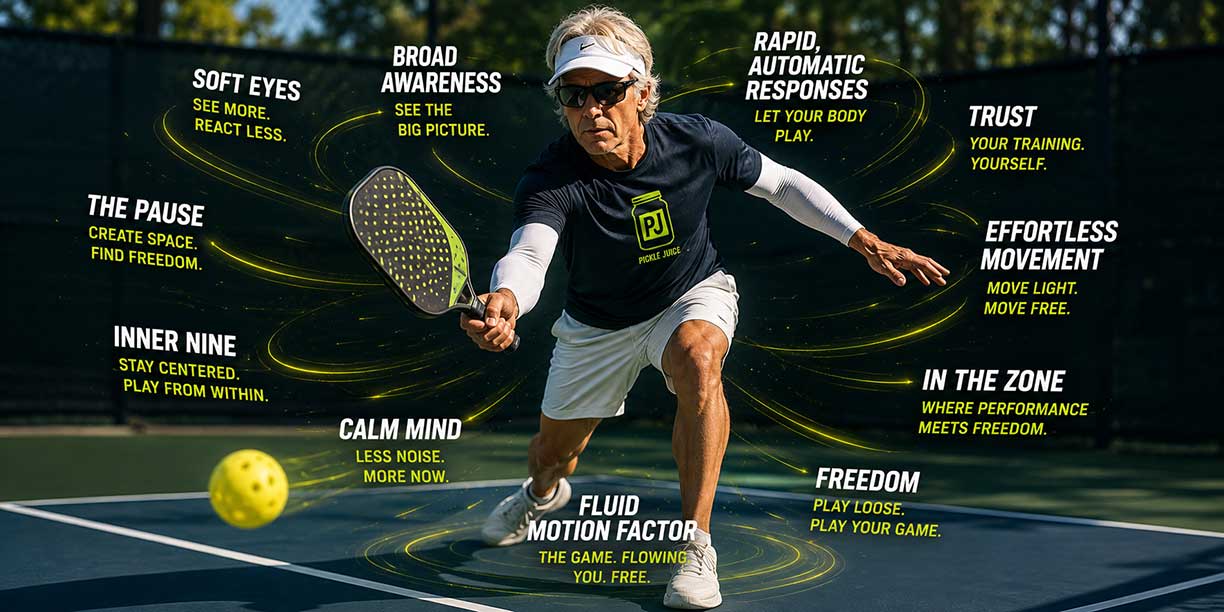
To stop overthinking in pickleball, give your body a simpler job. From the Fluid Motion Factor perspective, overthinking happens when the conscious mind tries to control movement, timing, touch, and shot selection in real time. Instead of giving yourself a long list of instructions, soften your eyes, acknowledge the ball, loosen your grip, feel your feet, and use one simple cue such as “smooth,” “wait,” or “receive.”
The Little Committee Inside Your Head
Every pickleball player has had the experience of playing a perfectly decent point until the mind decides to hold a meeting.
You are at the kitchen line. The ball is coming. It is not especially fast. It is not especially tricky. In fact, it is probably a ball you have handled hundreds of times before.
Then the committee arrives.
Bend your knees.
Keep your paddle up.
Don’t pop it up.
Watch the ball.
Hit it to the backhand.
No, maybe middle.
Don’t miss.
Why did you miss the last one?
Is your partner disappointed?
Are you disappointing pickleball itself?
And while this noisy little town council is still debating policy, the ball arrives.
Usually into the net.
This is overthinking. And from the Fluid Motion Factor perspective, it is not just a mental nuisance. It is physical interference.
The thinking brain has stepped into a movement system that already knows how to do many things without conscious micromanagement. The body can see, adjust, balance, time, soften, accelerate, and respond faster than the verbal mind can explain.
But when the conscious mind tries to run the whole shot from headquarters, movement gets tight. Timing gets late or rushed. Touch disappears. Vision narrows. The paddle starts to feel less like an extension of the hand and more like a courtroom exhibit.
Overthinking Is Usually Too Much Control
Most players assume overthinking means they lack focus.
Often, it means the opposite.
They are focusing too much, but in the wrong way.
They are not receiving the point. They are supervising it.
There is an important difference.
Useful awareness is quiet. It sees the ball, senses the court, feels the paddle, and allows the body to respond.
Overthinking is noisy. It turns every shot into a list of corrections. It tries to guarantee the result. It does not trust the body’s timing, so it adds instructions, warnings, and little emergency announcements.
This is why overthinking often shows up on easy shots.
The hard shot gives the body something to do. You react. You move. You play.
But the easy shot gives the mind time to interfere.
Here comes a simple return.
Here comes a floating put-away.
Here comes a dink that ought to be harmless.
And suddenly the mind says, “Let me help.”
This is not always helpful.
Why Thinking Too Much Hurts Natural Movement
Pickleball is fast enough that many of its best movements happen below the level of verbal instruction. You do not consciously calculate every paddle angle, every inch of spacing, every foot adjustment, every change in grip pressure.
The body organizes those things through practice, experience, vision, feel, and prediction.
That does not mean thinking has no role. Thinking is useful before and after points. It can help you notice patterns, choose a basic strategy, understand your opponent, or decide that you should stop speeding up balls from your shoelaces, a discovery most of us make eventually.
But during the point, too much thinking often gets in the way.
The conscious mind is useful for planning.
It is not ideal for micromanaging contact.
From the FMF point of view, the goal is not to turn the brain off. That would be both impossible and inconvenient if you need to remember the score. The goal is to stop the thinking mind from interfering with the body’s natural movement system.
You do not need less intelligence.
You need less internal traffic.
Start With Soft Eyes
One of the best ways to reduce overthinking is to change the quality of your seeing.
Many players try to “watch the ball” by staring harder. They clamp down visually. Their eyes get narrow. Their body gets tight. The court disappears, and the ball becomes a small yellow emergency.
Soft eyes are different.
Soft eyes allow you to see the ball without attacking it with your vision. You are still attentive, but your awareness is wider. You see the ball, but you also sense the court, the opponent, your partner, the net, the kitchen line, and the available space.
This matters because overthinking often happens when attention narrows into a tiny anxious tunnel.
Soft eyes widen the tunnel.
They give the body more information and the thinking mind less reason to panic.
A simple cue is:
Let the court come to you.
That phrase may sound gentle, but it is practical. When the visual system relaxes, movement often becomes more responsive, less forced, and less crowded by commentary.
Acknowledge the Ball Instead of Interrogating It
Another useful FMF phrase is:
Acknowledge the ball.
This is different from staring at the ball. It is also different from mentally attacking the ball with instructions.
To acknowledge the ball is to let it register. You receive it into awareness. You allow the body to organize around it.
The ball does not need a speech.
It does not need you to remind it that you missed the last dink. It does not need to hear your thoughts about your paddle angle, tournament prospects, or overall place in the moral universe.
It just needs to be seen.
Overthinking pulls you away from the ball and into commentary about the ball.
Acknowledge the ball brings you back.
Not the last ball.
Not the imagined next ball.
This ball.
That is where the body can work.
Use One Cue, Not a Coaching Manual
When players overthink, they often try to fix it by giving themselves more instructions.
This is understandable.
It is also like trying to put out a grease fire with a saxophone.
The mind is already too loud. Adding more advice usually makes the point more crowded.
Instead, use one cue.
One.
Not seven.
Good cues include:
- Soft eyes.
- Easy hands.
- Smooth.
- Wait.
- Receive.
- Feel the feet.
- Let it happen.
- See it.
The cue should be short enough to keep you in the point. It should point your attention toward an experience, not a mechanical checklist.
“Keep your paddle up, bend your knees, watch the ball, hit through the middle, don’t overhit, and don’t mess this up” is not a cue.
It is a traffic jam.
“Smooth” is a cue.
“Wait” is a cue.
“Soft eyes” is a cue.
The best cue gives the body direction without putting the thinking mind in charge of the whole operation.
Receive Before You Decide
Many overthinking mistakes happen because the player decides too early.
Before the ball has fully arrived, the mind has already chosen a shot.
Attack.
Dink.
Speed up.
Lob.
Drop.
Roll.
Heroic winner suitable for a bronze statue.
The problem is that the ball may not have agreed to this plan.
A better cue is:
Receive before you decide.
Let the ball arrive into awareness. Let your body feel the speed, height, spin, spacing, and balance of the situation. Then respond.
This does not mean being slow. It means not jumping ahead mentally.
Many rushed shots are not caused by fast balls. They are caused by early decisions.
The mind has already left for the result before the body has finished meeting the ball.
Receiving brings you back to contact.
Between Points, Think Lightly
There is a time for thought in pickleball.
Between points, you can notice patterns.
They are attacking my backhand.
Their third shots are floating.
We should make them hit one more ball.
I am rushing the return.
The middle is open.
That kind of thinking can help.
But even between points, keep it light.
The goal is not to write a novel about the match while standing at the baseline. The goal is to choose one useful adjustment and return to play.
A good between-point thought might be:
“Deep return.”
“Make them dink.”
“Middle.”
“Wait.”
“Soft hands.”
Then let it go.
Thinking should serve the point, not occupy the court like an overfunded bureaucracy.
Link to the Stop Overthinking Pillar Page
For a fuller explanation of why the thinking mind interferes with natural movement, see:
[How Do I Stop Overthinking in Pickleball?]
This pillar page explains the Fluid Motion Factor approach to overthinking: how the conscious mind disrupts timing, touch, rhythm, vision, and instinct, and how players can return to simpler, more natural play.
A Simple FMF Anti-Overthinking Reset
Here is a simple reset you can use before a serve, return, dink, or pressure point:
- Take one easy breath.
- Soften your eyes.
- Loosen your grip.
- Feel your feet.
- Acknowledge the ball.
- Use one cue.
That is enough.
The point is not to create a ritual so elaborate that you need a stage manager. The point is to give the body a clean doorway back into the game.
Overthinking thrives in clutter.
Fluid motion returns through simplicity.
The Goal Is Not to Stop Thought Completely
You will still think during pickleball.
Of course you will. You are a human being, not a decorative fern.
The goal is not to eliminate thought. The goal is to keep thought in its proper role.
Thinking can help you set intention.
Thinking can help you learn.
Thinking can help you notice patterns.
But thinking should not stand between you and the ball.
The best pickleball often feels simple because the body is allowed to do what it knows how to do. You see the ball. You move. You respond. The point unfolds.
You are present, but not crowded.
Aware, but not tense.
Engaged, but not overmanaged.
That is the direction FMF points toward.
Not more thought.
Better access.
Return to This Ball
Overthinking usually pulls you away from the present ball.
It drags you into the last mistake, the next point, your partner’s opinion, the score, the technique, the outcome, or the imaginary postgame press conference no one has asked you to attend.
The remedy is simple, though not always easy:
Return to this ball.
See it.
Receive it.
Let the body respond.
Not perfectly. Perfect is just another form of pressure wearing nicer shoes.
Just freely enough.
That is how you stop overthinking in pickleball: not by defeating the mind, but by giving it less to manage and giving the body more room to play.
FAQ:
Why do I overthink during pickleball?
You overthink because your conscious mind is trying to control movements that the body usually handles more naturally. This often happens under pressure, after mistakes, or on “easy” shots that give the mind too much time to interfere.
What is the fastest way to stop overthinking during a point?
Use one simple cue. Good examples include “soft eyes,” “smooth,” “wait,” “receive,” or “easy hands.” A short cue keeps your attention in the point. A long list of technical instructions usually creates more clutter.
How do soft eyes help with overthinking?
Soft eyes widen your awareness. Instead of staring tensely at the ball, you allow the ball and the court to remain in your visual field. This helps reduce strain, gives the body more useful information, and keeps the thinking mind from narrowing into panic.
Should I think about technique during a match?
A little technical awareness can help between points, but technique during a rally interferes with timing and touch. During play, it is better to use a simple cue rather than a detailed mechanical checklist.
Why do I overthink easy shots?
Easy shots often create expectation. Because you feel you “should” make them, the mind tries to guarantee the result. That extra control can lead to steering, tightening, rushing, or missing. The easier the shot looks, the more important it may be to stay simple.
What does “receive the ball” mean?
Receive the ball” means letting the ball fully arrive into your awareness before deciding what to do. Instead of choosing too early or forcing a shot, you allow the body to read the ball’s speed, height, and position, then respond naturally.


0 Comments